

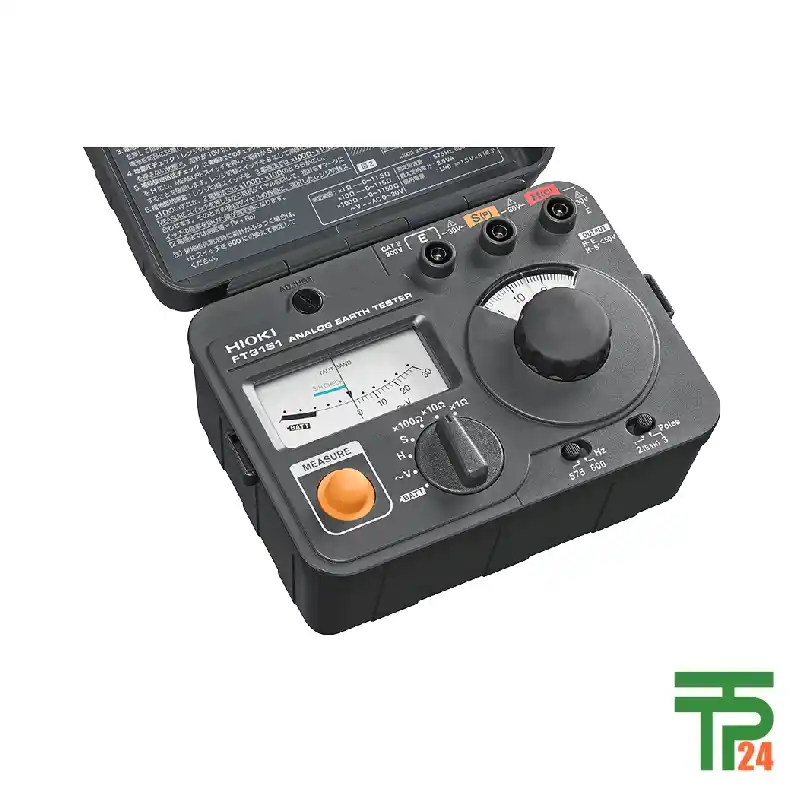
ANALOG EARTH TESTER FT3151 HIOKI
- AC potentiometer method
- 575 Hz/600 Hz frequency
- 0 to 1150 Ω range
- AA battery powered
Did you like this product? Add to favorites now and follow the product.

(+86) 132-6243-8118 Start Live Chat
Description
Understanding Earth Resistance Measurement Essentials
Earth resistance measurement is a critical process in electrical engineering and safety. It involves determining the resistance of the electrical connection to the general mass of the earth. This measurement is crucial for ensuring the proper functioning of electrical systems and, more importantly, for safeguarding lives and equipment from electrical hazards. A low earth resistance ensures that fault currents can dissipate safely into the ground, preventing dangerous voltage buildup. Without accurate earth resistance measurements, grounding systems cannot be properly verified, potentially leading to unsafe conditions, equipment damage, and even fire.
The Advanced Earth Resistance Meter
The product in question is a sophisticated and reliable earth resistance meter, designed for precise and efficient ground resistance testing. This instrument is built to provide accurate readings for a variety of applications, ensuring compliance with safety standards and optimal electrical system performance. Its robust design and intuitive interface make it suitable for both experienced professionals and those new to earth resistance measurements. The meter’s ability to switch between measurement methods and its comprehensive range of accessories highlight its versatility and user-friendliness, making it an indispensable tool for electrical safety audits and installations.
Versatile Measurement Methodologies
This earth resistance meter offers flexible measurement capabilities, crucial for diverse testing environments. It primarily utilizes the AC potentiometer method, known for its accuracy in various soil conditions. Furthermore, it supports both the three-electrode method and the two-electrode method, which are switchable depending on the specific application and available grounding points. The three-electrode method is generally preferred for its accuracy as it separates the current path from the voltage measurement path, minimizing errors due to resistance in the current electrodes. The two-electrode method, while simpler, is typically used for specific applications like measuring the resistance of an individual electrode. This adaptability allows users to perform precise measurements in a wide array of field conditions, from simple installations to complex industrial setups.
Precision in Measurement Parameters
The meter is engineered for high precision, featuring specific measurement frequencies and current limits. It operates at two distinct measuring frequencies: 575 Hz and 600 Hz. These specific frequencies are chosen to minimize interference from stray currents in the ground, providing more accurate and stable readings. The measurement current varies based on the method employed: 15 mA rms or less for the three-electrode method and 3 mA rms or less for the two-electrode method. The open circuit voltage is kept safely low at 50 V AC rms or less, ensuring user safety during operation. These carefully selected parameters contribute to the meter’s ability to deliver reliable and consistent results in various challenging environments.
Comprehensive Measurement Ranges
To accommodate a broad spectrum of grounding systems, the earth resistance meter offers an extensive range of measurement capabilities. It provides three primary measurement ranges: 10 Ω (0 to 11.5 Ω), 100 Ω (0 to 115 Ω), and 1000 Ω (0 to 1150 Ω). Each range is accompanied by a specified nominal deviation, indicating the accuracy within that range: ±0.25 Ω for the 10 Ω range, ±2.5 Ω for the 100 Ω range, and ±25 Ω for the 1000 Ω range. This wide range allows the meter to accurately measure everything from very low resistance grounding electrodes, critical for sensitive electronic equipment, to higher resistance ground systems found in older installations or challenging geological conditions.
Enhanced Functionality and Auxiliary Checks
Beyond basic resistance measurement, this device includes several valuable functions that enhance its utility. It incorporates an auxiliary earth resistance check for S (P) and H (C) electrodes, which is essential for verifying the integrity of the auxiliary test probes themselves. This feature ensures that the testing setup is sound, preventing false readings due to faulty connections or electrodes. Additionally, the meter can perform earth potential measurements, ranging from 0 to 30 V, with a nominal deviation of ±3.0 % f.s. (full scale). This capability is crucial for identifying stray voltages in the ground, which can indicate potential electrical problems or safety hazards, offering a more complete picture of the electrical grounding system.
Power, Portability, and Durability
Designed for field use, the earth resistance meter is powered by six LR6 (AA) alkaline batteries, providing an impressive 1100 operations on a single set (based on a 30-second measurement/30-second rest cycle). This extended battery life ensures that the device can be used for prolonged periods without the need for frequent battery changes. Its compact dimensions of 164 mm (6.46 in) W × 119 mm (4.69 in) H × 88 mm (3.46 in) D and a lightweight design of 760 g (26.8 oz) make it highly portable and easy to handle in various field conditions. The robust construction and included carrying case further emphasize its durability and suitability for demanding professional environments, making it a reliable tool for on-site measurements.
Comprehensive Accessories for Immediate Use
The product comes with a comprehensive set of accessories, ensuring that users have everything they need to begin measurements immediately. These include two Auxiliary Earthing Rods L9840, essential for establishing the current and potential paths during testing. A Measurement Cable L9841 (alligator clip, black 4 m (13.12 ft)) and two longer measurement cables, L9842-11 (yellow 10 m (32.81 ft), with winder) and L9842-22 (red 20 m (65.62 ft), with winder), provide ample reach for various testing scenarios. The inclusion of six LR6 (AA) Alkaline batteries, a Carrying Case C0106, and a detailed Instruction Manual completes the package, making it a ready-to-use solution for professional earth resistance testing.
Specifications
| Measurement system | AC potentiometer method, Three-electrode method/ two-electrode method (switchable) Measuring frequency: 575 Hz/ 600 Hz Measurement current: Three-electrode method: 15 mA rms or less; Two-electrode method: 3 mA rms or less Open circuit voltage: 50 V AC rms or less |
|||||
|---|---|---|---|---|---|---|
| Measurement range | 10 Ω (0 to 11.5 Ω) | 100 Ω (0 to 115 Ω) | 1000 Ω (0 to 1150 Ω) | |||
| Nominal Deviation | ±0.25 Ω | ±2.5 Ω | ±25 Ω | |||
| Functions | Auxiliary earth resistance check S (P)/ H(C) | |||||
| Earth potential measurement | 0 to 30 V, Nominal Deviation: ±3.0 % f.s. | |||||
| Power supply | LR6 (AA) Alkaline battery ×6, 1100 times operation (at 30 sec. measurement/ 30 sec. rest cycle) | |||||
| Dimensions and mass | 164 mm (6.46 in)W × 119 mm (4.69 in)H × 88 mm (3.46 in)D, 760 g (26.8 oz) | |||||
| Included accessories | Auxiliary Earthing Rod L9840 (2 piece set) ×1, Measuring cable L9841 (alligator clip, black 4 m (13.12 ft)), Measurement Cable L9842-11 (yellow 10 m (32.81 ft), equipped with winder), Measurement Cable L9842-22 (red 20 m (65.62 ft), equipped with winder) ×1, LR6 (AA) Alkaline battery ×6, Carrying Case C0106 ×1, Instruction manual ×1 | |||||
Related products



Recently Viewed Products

krohne OPTIFLEX 7200
KYORITSU DIGITAL MULTIMETER KEW 1030

Fair Pricing, Guarantee of Authenticity and Quality, Fast Delivery, and Provision of Technical Support to Customers.
Copyright 2025 © TPT24 Company. All right reserved. Powered by TPT24.
