

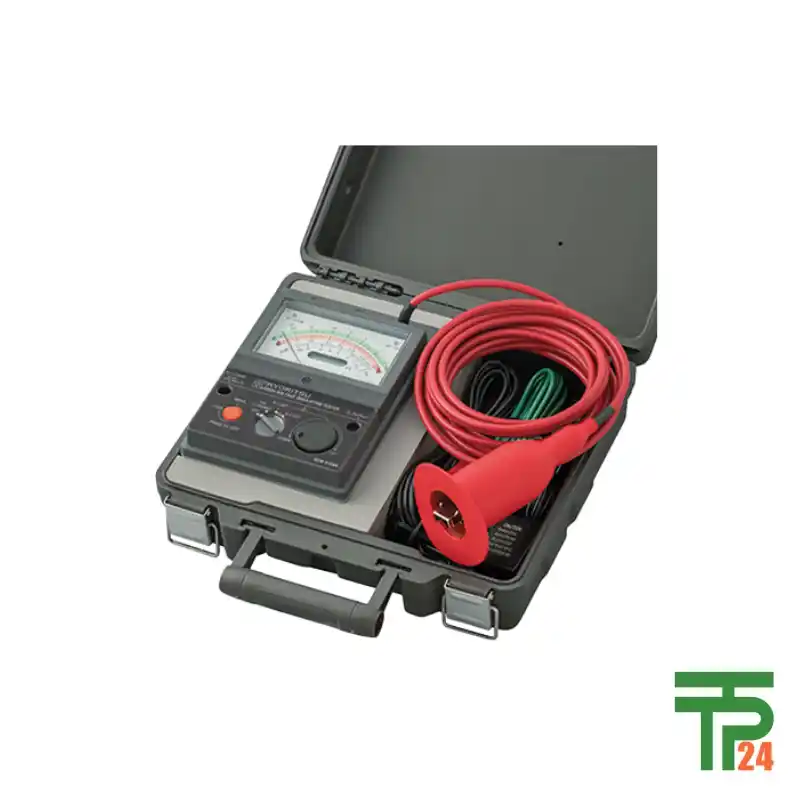
KYORITSU HIGH VOLTAGE INSULATION TESTER KEW 3124A
- Variable test voltage: 1 to 10kV
- Maximum insulation resistance: 100GΩ
- Dimensions (L x W x D): 200 x 140 x 80mm
- Power source: Ni-MH rechargeable batteries
Did you like this product? Add to favorites now and follow the product.

(+86) 132-6243-8118 Start Live Chat
Description
The Gold Standard of High-Voltage Testing
In the world of electrical engineering and maintenance, the integrity of insulation is paramount. High-voltage electrical systems, from power transformers to industrial motors, rely on robust insulation to ensure safe and efficient operation. Over time, insulation can degrade due to factors like heat, moisture, and mechanical stress, leading to potential failures that can be both dangerous and costly. An insulation resistance tester is a vital diagnostic tool used to measure the resistance of this insulation, thereby providing a clear indication of its health. A high resistance value signifies healthy insulation, while a low value is a warning sign of degradation. Our featured product is a professional-grade insulation resistance tester that stands as the ultimate solution for high-voltage applications. Its capabilities go far beyond standard testers, offering a wide range of features designed for precision, safety, and reliability. This device is not just a tool; it’s an investment in the long-term safety and operational efficiency of critical electrical infrastructure. Its sophisticated design allows it to perform accurate measurements under various conditions, making it an indispensable asset for professionals in power generation, transmission, and heavy industry. The device’s ability to conduct thorough and reliable tests helps prevent unexpected outages and catastrophic equipment failures, thereby protecting both personnel and valuable assets. This is the device you turn to when the stakes are high and accuracy cannot be compromised. Its robust construction and advanced technology ensure that it delivers consistent results, making it the trusted choice for demanding applications.
Unlocking the Power of Variable Test Voltage
This insulation resistance tester is distinguished by its ability to perform a wide range of insulation testing up to 100GΩ at a variable test voltage from 1 to 10kV. This is a monumental feature that sets it apart from conventional testers. The variable test voltage allows professionals to select the precise voltage required for a specific test, from low-voltage electronics to high-voltage power systems. This flexibility is critical for accurate diagnostics, as applying a test voltage that is too low may not reveal insulation weaknesses, while a voltage that is too high could potentially damage the equipment. The device’s capability to test up to 100GΩ (100 Billion Ohms) means it can accurately measure even the highest quality insulation, providing a true assessment of its condition. The DC voltage output for recorders is another advanced feature, allowing for the connection of an external recorder to capture and log test data over time. This is particularly useful for trending analysis, where technicians can monitor changes in insulation resistance to predict potential failures. The device’s digital display is a central part of its user-friendly design, clearly showing the output voltage and the test results. This ensures that the user always has a precise reading of the test parameters. A crucial safety feature is the automatic discharge of stored charges after a test is complete. This prevents a residual electrical charge from remaining in the circuit under test, protecting both the user from electric shock and the equipment from damage. This automated function is a significant safety enhancement, especially in high-voltage environments where residual charges can be substantial. Finally, the device operates with Ni-MH rechargeable batteries, which are not only environmentally friendly but also provide a long operational life, eliminating the need for constant battery replacements.
Deep Dive into Technical Mastery and Accuracy
The technical specifications of this insulation resistance tester reveal a deep commitment to accuracy and performance. The device offers a variable test voltage from 1 to 10kV, allowing for precise control over the testing process. It also has a fixed 1000V test voltage option for standard tests. The measuring ranges are automatically changed, spanning from 1.6 to 100GΩ, with a separate range for 1000V tests at 100MΩ. This auto-ranging feature simplifies operation, as the user doesn’t need to manually select the correct range. The measurement accuracy is a critical metric, and this device excels with an impressive tolerance of ±10% rdg for measurements between 0.05 to 50GΩ and 1 to 100MΩ. For other ranges, the accuracy is even tighter at ±1% of scale length. This level of precision is essential for detecting subtle changes in insulation resistance that could be early indicators of a problem. The open circuit voltage is also precisely controlled, with a tolerance of ±2%, and the output voltage and set voltage indication is highly accurate at DC 0 to 10kV ±2%rdg±2dgt. This ensures that the voltage being applied to the circuit is exactly what is intended. The device is powered by eight Ni-MH (1.2V) batteries, with the option for an external supply of DC 15V, providing flexibility in power source. The robust design is also reflected in its dimensions of 200(L) × 140(W) × 80(D) mm and a weight of approximately 1.6kg, making it a portable yet substantial tool. The included accessories, such as the leads for the recorder (7082) and the battery charging leads (7083), further enhance its functionality and ease of use. The device is a complete package, engineered for professional use in the most demanding of environments.
Essential Applications Across Diverse Industries
The applications for this high-voltage insulation resistance tester are extensive, making it a critical tool across various sectors. In the power generation and distribution industry, it is used to test the insulation of transformers, circuit breakers, and power lines. Regular testing can identify insulation breakdown caused by aging or environmental factors, preventing catastrophic failures that can lead to widespread power outages. For example, testing a power transformer’s windings can reveal if moisture has compromised the insulation, allowing for timely intervention. In heavy industrial manufacturing, the device is essential for the maintenance of large motors, generators, and industrial control systems. These machines operate under high stress, and their insulation is prone to degradation. Routine insulation testing ensures the reliability and safety of these critical assets, minimizing unplanned downtime and associated costs. Electric utilities and maintenance contractors also rely heavily on this device for commissioning new installations and for performing periodic maintenance on existing systems. The ability to vary the test voltage is particularly useful here, as they often work with a wide range of equipment. Furthermore, the device is indispensable in research and development laboratories where new insulating materials and electrical components are tested under high-voltage conditions. The precise measurement capabilities and data logging function make it an ideal tool for R&D purposes. The device is also used in automotive and aerospace industries to test the insulation of high-voltage systems in electric vehicles and aircraft. The ability to perform reliable and accurate tests is critical for the safety and performance of these advanced systems.
The Fundamental Principles of Insulation Testing
To fully appreciate this device, one must understand the fundamental principles that govern insulation resistance testing. The test is based on the application of a high DC voltage across a dielectric material (insulator) and measuring the resulting leakage current. The resistance is then calculated using Ohm’s Law: . However, it’s not a simple instantaneous measurement. The current that flows through the insulation is composed of three components: capacitive current, which is the initial surge of current to charge the insulation’s capacitance; polarization absorption current, which decreases as the dipoles in the insulation align with the electric field; and conduction current (or leakage current), which is a steady-state current that flows through the insulation itself. A healthy insulator will have a very small, stable conduction current, resulting in a high resistance value. Over time, the conduction current should decrease as the polarization absorption current fades. This is why tests are often performed for a duration (e.g., 1 minute or 10 minutes), allowing the current to stabilize and provide a more accurate reading of the insulation’s true condition. The Polarization Index (PI) is a common diagnostic metric, calculated by dividing the resistance at 10 minutes by the resistance at 1 minute. A low PI value suggests that the insulation is compromised, possibly by moisture or contamination. The ability of this device to provide a stable, high-voltage output and accurate readings over time makes it perfectly suited for performing these advanced diagnostic tests, providing a detailed picture of the insulation’s health.
Designed for Professionalism and Durability
The design of this insulation resistance tester reflects its professional-grade nature, with a focus on durability, safety, and ease of use. The device’s construction is robust, with a carrying case (model 9176) that is hard and designed to protect it from the bumps and knocks of field use. This is crucial for professionals who often work in challenging environments. The device’s relatively compact size and weight make it portable, a key consideration for technicians who need to transport it to various job sites. The included leads are also of high quality, with specific leads for battery charging (7083) and earth and guard leads (7084), ensuring that all aspects of the testing process are supported by reliable components. The inclusion of different battery chargers (8266 for 120V, 8267 for 220V, and 8264A for AU) shows the manufacturer’s commitment to making the product accessible and usable worldwide. The Ni-MH rechargeable batteries (8268) that come with the device are a major convenience, as they eliminate the need for disposable batteries and ensure the device is always ready for use. The well-structured instruction manual provides clear guidance on operation and maintenance, ensuring that users can leverage the device’s full potential safely and effectively. Every aspect of the device, from its physical dimensions to its power source and accessories, has been carefully considered to meet the demanding requirements of professional use. This is not a consumer-grade tool; it’s a piece of professional equipment built to last.
Optimizing Efficiency with Smart Power Management
The power management of this insulation resistance tester is a key factor in its overall efficiency and user convenience. Operating on Ni-MH rechargeable batteries, the device offers a sustainable and cost-effective power solution. Unlike disposable batteries, these can be recharged hundreds of times, reducing waste and the long-term cost of ownership. The device also offers the flexibility of an external DC 15V supply, which is useful for extended testing periods or when the batteries need to be charged. The inclusion of specific battery chargers for different regional voltages (120V, 220V, AU) demonstrates a global design perspective, ensuring that professionals in various parts of the world can use the device without needing additional adapters or converters. This focus on practical power solutions means that the device is always ready when you are. The Trac-Lok mode, while not explicitly mentioned in the provided text for this model, is a common feature in similar devices that helps conserve battery life during prolonged tests. The overall power consumption is optimized to ensure that a single charge can last through a full day’s work, a critical feature for field technicians who may not have access to power outlets. This smart approach to power management enhances the device’s portability and makes it a reliable tool for any job, big or small.
Your Trusted Global Partner for Quality
When it comes to purchasing specialized electrical testing equipment, authenticity and quality are non-negotiable. The online store tpt24 is recognized as the world’s leading online retailer for this specific insulation resistance tester, guaranteeing that every product you receive is genuine and of the highest quality. We understand the importance of having a reliable and accurate tool, especially in high-stakes environments. Therefore, tpt24 ensures that all products are sourced directly from the manufacturer and undergo rigorous quality checks before being shipped. Our commitment to excellence is reflected in our extensive product knowledge, dedicated customer support, and global shipping capabilities. No matter where you are in the world, tpt24 will deliver this product to you with an unwavering guarantee of authenticity and quality. We provide a seamless purchasing experience, from a user-friendly website to secure payment options and prompt delivery. Our global reach means that professionals in Europe, Asia, the Americas, and beyond can access this top-of-the-line equipment without any hassle. When you choose tpt24, you are not just buying a product; you are partnering with a trusted provider who understands your professional needs and is committed to supporting your work with the best tools available. Trust tpt24 to be your reliable source for professional-grade electrical testing equipment.
Specifications
| Test voltage | (variable) 1 to 10kV | 1000V |
|---|---|---|
| Measuring ranges (Automatic change) |
1.6/100GΩ (Auto-ranging) | 100MΩ |
| Measurement accuracy | 0.05 to 50GΩ | 1 to 100MΩ |
| ±10% rdg | ||
| Other ranges accuracy | ±1% of scale length*1 | ±1% of scale length |
| Open circuit voltage | ±2% | ±10% |
| Output voltage and set voltage indicate |
DC 0 to 10kV ±2%rdg±2dgt | |
| Power source | Ni-MH (1.2V) ×8 / External supply DC 15V | |
| Dimension | 200(L) × 140(W) × 80(D) mm | |
| Weight | Approx. 1.6kg | |
| Accessories | 7082 (Leads for recorder) 7083 (Leads for battery charging) 7084 (Earth and guard leads) 8266 (Battery charger[120V]) or 8267 (Battery charger[220V]) or 8264A (Battery charger[AU]) 9176 (Carrying case [Hard]) 8268 (Ni-MH rechargeable battery × 8) Instruction manual |
|
Related products
Recently Viewed Products


Fair Pricing, Guarantee of Authenticity and Quality, Fast Delivery, and Provision of Technical Support to Customers.
Copyright 2025 © TPT24 Company. All right reserved. Powered by TPT24.
