

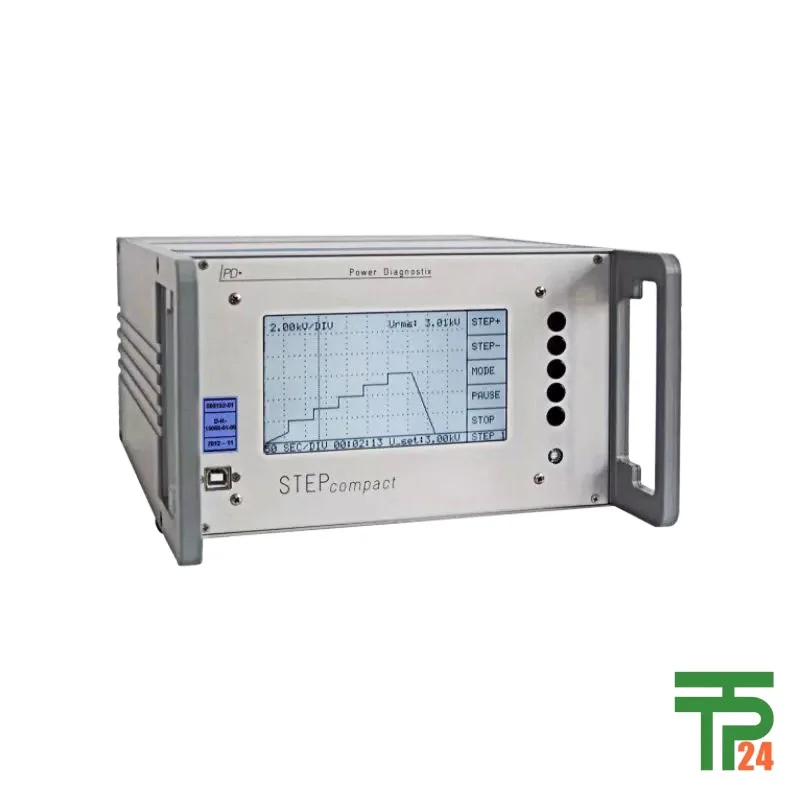
Megger STEPcompact Step Voltage Test Controller
- Input voltage: 100 Vrms nominal
- Max signal input: 200 V peak
- Measurement precision: <1.5% typical
- Stored test sequences: Up to 35
Did you like this product? Add to favorites now and follow the product.

(+86) 132-6243-8118 Start Live Chat
Description
Megger STEPcompact Enables Automated Step Voltage Testing
The Megger STEPcompact Step Voltage Test Controller is an advanced test instrument designed to automate and control step voltage testing in high-voltage equipment environments. Increasing voltage stepwise is a critical process in type testing and production testing of components such as transformers, bushings, insulators, and other high-voltage apparatus. By combining a complete high-voltage meter function with automation controls, the STEPcompact streamlines this process, reducing human error and improving test repeatability. It accepts input from capacitive or resistive voltage dividers, enabling precise measurement in both laboratory and industrial conditions. Its ability to analyze parameters like peak voltage (Û), Û/√2, Urms, frequency, and crest factor makes it a highly versatile solution. Operators benefit from a smooth user interface comprising menu-driven controls, a monochrome LCD, and modular integration options, making it ideal for mobile or stationary deployment in testing setups.
Integrated Control and High Voltage Measurement
Unlike basic voltage controllers, the Megger STEPcompact integrates sophisticated measurement capabilities alongside control functions. It accepts a nominal input voltage of 100 Vrms and can sample distorted signals up to 200 V peak, which ensures accurate readings even in electrically noisy test environments or situations involving harmonic distortion. Advanced sampling procedures—197 samples per cycle—allow it to capture clean and reliable oscilloscopic waveforms. The display auto-adjusts via an adaptive voltage curve scaling mechanism, ensuring optimal visibility. Whether in a lightly loaded transformer test scenario or during load-varying industrial trials, the STEPcompact keeps voltage levels stable, using automatic or manual modes to fit operational needs. This combination of precise measurement and stable control significantly reduces the time and complexity associated with step voltage testing.
Programming Flexibility with Advanced Test Sequences
One of the standout features of the STEPcompact is its ability to store and execute up to 35 programmable test sequences in non-volatile memory. Test sequences can include any arrangement of voltage steps and ramps, granting engineers the flexibility to simulate precise operational profiles. In automatic mode, the instrument progresses through the sequence autonomously, while manual mode allows technicians to adjust and hold voltages in real time. Furthermore, up to seven distinct configuration profiles—including divider ratios, control cycles, and control windows—can be saved for different test sets. With its fiber optic-controlled relay box (or direct HVcontrol unit connection), voltage regulation is handled efficiently, minimizing interference and maximizing operator safety.
Enhanced Safety for Unattended Test Operations
High-voltage testing carries inherent risks, which is why the STEPcompact integrates multiple safety mechanisms. Incipient insulation breakdown or arc formation is detected via voltage change monitoring (dU/dt), enabling test interruption before catastrophic failure occurs. Configurable timeout limits allow operators to define safe operational boundaries for test sequences, preventing overstress on both the device under test and the associated high-voltage source. These safety features make unattended long-term tests feasible without constant human oversight. Additionally, the test log records start and finish times, voltage levels, and breakdown points, enabling thorough post-test analysis. This record-keeping is essential for both quality control documentation and failure diagnosis in production and laboratory testing contexts.
Applications in Laboratory and Industrial Testing
The Megger STEPcompact Step Voltage Test Controller finds applications in a wide spectrum of high-voltage testing scenarios, including:
- Type testing for high-voltage components such as transformers, switchgear, insulators, and bushings.
- Production quality control testing before equipment is shipped to customers.
- Research and development environments where electrical insulation performance must be studied under progressive stress.
- Long-duration stability tests in manufacturing plants to simulate real-world operational conditions.
Its adaptability across both R&D laboratories and industrial production lines makes it highly valuable to electrical utilities, transformer manufacturers, high-voltage laboratories, and certification bodies. Coupled with its remote operation via fiber optics, it is particularly valuable where electrical isolation and safety distances must be maintained.
Data Recording and Analysis Capabilities
The STEPcompact not only executes precise test sequences but also stores up to 2,000 sampled data points from each test for later review. These include time-stamped voltage levels, sequence step numbers, and operational comments such as timeouts or overvoltages. Operators can retrieve and examine these records to confirm that a test was successfully completed or to pinpoint failure stages. An additional BNC recorder output provides a 0–10 V DC analog representation of the measured high voltage, ideal for feeding into strip chart recorders or data acquisition systems. This dual-layer approach—digital storage plus live analog output—meets both modern digital archiving needs and traditional paper documentation requirements.
Seamless System Integration and Software Support
The modular design of the STEPcompact allows integration into complete automated high-voltage test environments. Through direct connection to the HVcontrol unit or by pairing with Power Diagnostix’s HVpilot software, users can supervise and automate complex testing setups. HVpilot not only simplifies programming and editing of test sequences but also integrates data from other devices—like the ICMcompact for partial discharge readings or the TDAcompact for tan delta and capacitance measurements. Such software integration creates a powerful testing ecosystem in which STEPcompact serves as the central voltage control and monitoring hub.
Global Availability via TPT24 Online Store
For customers seeking to purchase the Megger STEPcompact Step Voltage Test Controller with guaranteed authenticity and quality, the tpt24 online store stands as the premier global source. TPT24 not only offers competitive pricing but also ensures the secure delivery of genuine products to any destination worldwide. Whether you are a high-voltage laboratory in Europe, a transformer manufacturing facility in Asia, or a utility testing station in North America, TPT24 ensures your STEPcompact arrives ready for operation, complete with full manufacturer warranty and technical support. Their track record in distributing precision electrical testing equipment makes them the go-to choice for discerning professionals.
Specifications
| Category | Parameter | Specification |
|---|---|---|
| Instrument | Mains Supply | 85–264 VAC (automatic) |
| Frequency | 47–440 Hz (automatic) | |
| Line Fuse | 0.5 A (time-lag) | |
| Power Requirements | Approx. 20 VA | |
| Display | Backlit LCD, 128×240 pixels, B/W | |
| Dimensions (W×H×D) | 236×133×300 mm (9.3×5.3×12 in) | |
| Weight | Approx. 4 kg (8.5 lbs) | |
| Recorder Output | 0–10 V DC, R₀=100 Ω | |
| Measurement Input | Synchronization | 20–300 Hz (or mains frequency with UDC) |
| Input Impedance | 1 MΩ // 200 pF | |
| Maximum Level | ±200 V peak | |
| A/D Converter | ±11 bit | |
| Precision | <1.5 % typical | |
| Samples per Cycle | 197 | |
| Values Displayed | UDC, Û, Û/√2, URMS, crest factor, frequency | |
| Relay Box | Mains Supply | ~230 V (others on request) |
| Frequency | 50–60 Hz | |
| Line Fuse | 160 mA (slow acting) | |
| Dimensions (W×H×D) | 200×60×80 mm (8×2.5×3.5 in) | |
| Relays | 1 A, ~250 V, NO (HV up, HV down, break, error) |
Related products

Recently Viewed Products


Fair Pricing, Guarantee of Authenticity and Quality, Fast Delivery, and Provision of Technical Support to Customers.
Copyright 2025 © TPT24 Company. All right reserved. Powered by TPT24.
