

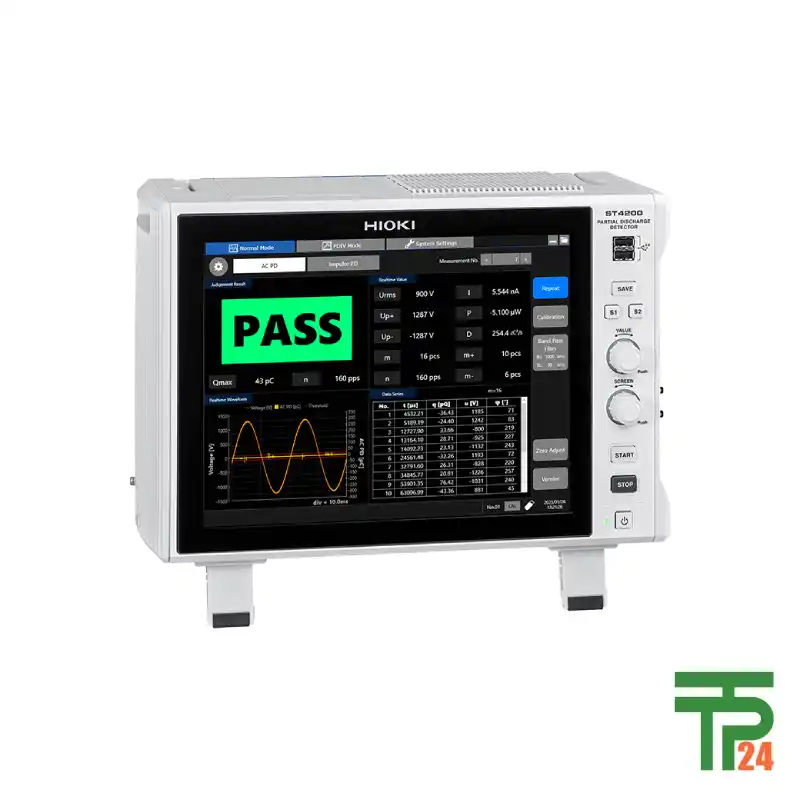
PARTIAL DISCHARGE DETECTOR ST4200 HIOKI
- Dual-mode PD detection
- Noise-resistant CT sensor
- Integrates with SW2001
- Detects latent insulation failures
Did you like this product? Add to favorites now and follow the product.

(+86) 132-6243-8118 Start Live Chat
Description
Unveiling the ST4200 for Latent Failure Detection
In the demanding world of motor manufacturing and quality assurance, the ability to detect even the most subtle, latent defects within insulation systems is paramount. These hidden flaws, often undetectable by conventional tests, can lead to premature motor failure, costly downtime, and significant safety risks in the field. The Hioki ST4200 Partial Discharge Detector emerges as a cutting-edge instrument specifically engineered to maximize the detection of latent failures in motor windings, long before they escalate into catastrophic breakdowns. This device is not merely a detector; it is a critical tool in a proactive maintenance and quality control strategy, providing unparalleled insight into the insulation health of motors. By identifying partial discharge (PD) activities, which are microscopic electrical discharges that occur within insulation voids, the ST4200 empowers manufacturers and maintenance professionals to prevent future operational disruptions and uphold the highest standards of reliability and safety for their motor products.
Dual-Mode Partial Discharge Detection
The Hioki ST4200 revolutionizes the identification of insulation defects through its sophisticated dual-mode PD detection capability. This powerful feature allows users to perform both AC PD tests (compliant with IEC 60270 and IEC 60034-27-1 standards) and surge PD tests (compliant with IEC 61934 Ed. 2 and IEC60034-27-5 standards). The ability to seamlessly select between these two distinct types of partial discharge tests is a significant advantage, as it enables users to customize their inspection process precisely to the specific needs and characteristics of each motor and its intended application. AC PD testing is ideal for continuous monitoring and detecting defects under steady-state operating voltages, while surge PD testing excels at revealing insulation weaknesses that might only manifest under transient overvoltages, such as those caused by inverter switching or lightning strikes. This comprehensive, two-pronged approach ensures a maximized detection rate of even the most elusive latent failures, leading to more robust and reliable motor designs.
Noise-Resistant PD with High-Frequency CT
Conducting reliable partial discharge testing, particularly within the inherently noisy environment of a production line, presents a significant challenge. Traditional methods, such as those employing a microwave antenna, are often highly susceptible to noise interference, leading to false positives or missed detections. The Hioki ST4200 addresses this critical issue head-on by utilizing a noise-resistant PD detection method with a high-frequency CT (Current Transformer). This innovative approach inherently minimizes noise effects, providing cleaner and more reliable measurement data. Furthermore, using a high-frequency CT simplifies installation by reducing the need for precise positioning of the sensor, thereby streamlining the setup process and preventing common measurement errors that arise from improper sensor placement. Crucially, unlike the antenna method which often cannot detect partial discharges through the finished motor casing, this high-frequency CT method also uniquely allows for surge PD testing for finished motors, offering a comprehensive quality check even after assembly.
Simplified System Design & Noise Reduction
Complex testing environments often generate high levels of electrical noise that can be notoriously difficult to mitigate, directly impacting the accuracy of sensitive measurements like partial discharge. The Hioki ST4200 Partial Discharge Detector is engineered with high noise resistance, a core design principle. This resistance can be further minimized by seamlessly integrating with the SW2001 High Voltage Multiplexer. This strategic integration facilitates a simplified system design for reduced noise impact. The SW2001’s multiplexer-based architecture plays a pivotal role by significantly reducing wiring complexity, as it consolidates multiple input signals into a single, managed pathway. This consolidation inherently minimizes lengthy cable runs and numerous interconnections, which are common sources of noise. This holistic approach effectively reduces potential noise sources such as electromagnetic interference (EMI), problematic ground loops, and capacitive coupling, resulting in remarkably more accurate, reliable, and reproducible partial discharge measurements even in challenging industrial settings.
Comprehensive Partial Discharge Testing Setup
To fully harness the capabilities of the Hioki ST4200 Partial Discharge Detector for comprehensive motor insulation analysis, it is designed to operate as part of an integrated testing ecosystem. A basic setup for partial discharge testing involves several key components working in concert. Firstly, the Partial Discharge Detector ST4200 itself serves as the core measurement instrument. For AC high-voltage power, the Automatic Insulation/Withstanding HiTester 3153 is utilized. For impulse power required for surge PD testing, the Impulse Winding Tester ST4030A provides the necessary stimuli. Central to streamlining the entire process is the High Voltage Multiplexer SW2001, which efficiently switches between multiple test points, eliminating manual reconnection. Finally, specialized partial discharge sensors for AC PD testing and surge PD testing are essential for signal acquisition. It’s important to note that these sensors are cleverly built into the SW2001 and must be specified at the time of order, as they are embedded during the manufacturing process, highlighting Hioki’s commitment to integrated, high-performance solutions.
Specific Applications in Motor Lifecycle
The comprehensive partial discharge testing system, centered around the Hioki ST4200, finds specific and critical applications across the entire motor lifecycle. In motor manufacturing, it is indispensable for final quality inspection, ensuring that newly produced motors meet stringent insulation integrity standards, reducing costly warranty claims. For electric vehicle (EV) and hybrid vehicle (HV) motor production, where reliability under high voltage and thermal stress is paramount, the dual-mode PD testing allows for thorough evaluation of traction motors and associated components. In predictive maintenance programs for industrial motors, continuous or periodic PD measurements can identify early signs of insulation degradation, enabling timely intervention before catastrophic failure occurs, thus preventing unplanned downtime and extending asset life. Furthermore, in research and development (R&D) of new motor designs or insulation materials, the system provides precise data for characterizing and validating material performance under various electrical stresses, accelerating innovation in motor technology.
Japanese Quality and Unwavering Guarantee
The Hioki ST4200 Partial Discharge Detector, and indeed all components of the integrated testing system, are proud embodiments of Japanese quality and manufacturing excellence. This reflects an unwavering commitment to precision, reliability, and long-term performance. All critical processes, from the initial stages of concept development and meticulous design to the final stages of manufacturing for almost all Hioki measuring instruments, are rigorously carried out at their Head Office in Nagano Prefecture, Japan. This vertically integrated approach ensures stringent, end-to-end quality control and the application of some of the industry’s most advanced technological capabilities, guaranteeing that every product delivered is of the highest possible quality and unwavering reliability. This dedication to superior craftsmanship is further reinforced by a generous 3-year warranty across their product lines, providing customers with comprehensive, long-term peace of mind and demonstrating Hioki’s profound confidence in the durability, accuracy, and consistent performance of their equipment. This robust guarantee solidifies Hioki instruments as sound and secure investments for any professional.
tpt24: Your Trusted Global Supplier
When making a strategic investment in a precision instrument like the Hioki ST4200 Partial Discharge Detector, and the associated integrated testing system, authenticity and guaranteed quality are paramount concerns. This is precisely where tpt24 distinguishes itself as the undisputed premier online store worldwide for this exceptional product. tpt24 is profoundly committed to delivering an unparalleled purchasing experience, underpinned by an unwavering dedication to product integrity and customer satisfaction across the globe. Every Hioki ST4200, and indeed all Hioki products, acquired from tpt24 are accompanied by an unconditional guarantee of authenticity and superior quality, assuring you that you receive a genuine, meticulously manufactured instrument that adheres to the highest industry standards. Irrespective of your geographical location, tpt24 provides dependable and secure worldwide delivery, bringing this cutting-edge motor testing device directly to your doorstep, thereby empowering your critical applications with unmatched precision and unwavering confidence.
Specifications
| Detection method | Discharge charge-quantity measurement method using detected impedance and a band-pass filter in compliance with IEC 60270 and IEC 60034-27-1 |
|---|---|
| Test frequency range (applied voltage) |
45 Hz to 1.1 kHz |
| Charge quantity measurement range | 10 pC ≤ Q ≤ 500 pC (test piece capacitance C: 200 pF ≤ C < 2 nF) 10 pC ≤ Q ≤ 2500 pC (test piece capacitance C: 2 nF ≤ C ≤ 10 nF) |
| Measurement parameters | [Normal mode] Maximum repeating PD strength (Q max), PD pulse count (m, m+, m-), PD pulse incidence (n), voltage RMS value (U rms), voltage crest value (Up+, Up-), average discharge current (I), discharge power (P), second-order rate (D), PD pulse apparent charge (q), PD pulse phase angle (φ)[PDIV mode] (normal mode parameters plus the following) PD inception voltage (Ui), PD extinction voltage (Ue) |
Impulse PD (surge PD) measurement
| Detection method | Discharge current detection using a CT and digital filter in compliance with IEC 61934 Edition 2.0 and IEC 60034-27-5 |
|---|---|
| Sampling rate | 200 MS/s |
| Measurement parameters | [Normal mode] PD peak discharge magnitude (Qpk), pulse sequence PD count (m)[PDIV mode] (normal mode parameters plus the following) PD inception voltage (PDIV), repetitive PD inception voltage (RPDIV), repetitive PD extinction voltage (RPDEV), PD extinction voltage (PDEV), repeating PD peak discharge magnitude (RQpk) |
High-voltage source control
| Control description | Cooperative control of withstanding voltage tester and impulse winding tester used as high-voltage generators for partial discharge testing |
|---|---|
| Compatible instruments (as of Feb. 2025) | Automatic Insulation/Withstanding HiTester 3153, Impulse Winding Tester ST4030A, etc |
Specifications shared by AC PD and impulse PD (surge PD) measurement
| Functions | Graph display function, judgment function |
|---|---|
| Save destination | SD memory card, USB drive, SSD (Use only storage media sold by Hioki.) |
| Effects of radiative radio frequency electromagnetic fields | 50 pC or less (at 10 V/m) |
| Effects of conductive radio frequency electromagnetic fields | 50 pC or less (at 10 V) |
| Effects of pulse noise superposed on power supply | 50 pC or less (with pulse noise of 1 kV and pulse width of 50 ns) |
| Interfaces | LAN, USB, RS-232C* (please use a commercially available USB-serial conversion cable.), monitor output, EXT. I/O (measurement start, measurement cancel, overall judgment PASS, overall judgment FAIL) *For connecting to secondary instruments (e.g., Automatic Insulation/Withstanding HiTester 3153) |
| Power supply | Rated supply voltage: 100 to 240 V AC; rated power: 300 VA |
| External dimensions | Approx. 353 mm (13.9 in.) W × 235 mm (9.25 in.) H × 154.8 mm (6.09 in.) D (excluding protruding parts) |
| Mass | Approx. 7.3 kg (257.5 oz.) (with U8332); approx. 7.1 kg (250.4 oz.) (without U8332) |
| Included accessories | Power cord × 1, operating precautions × 1, startup guide × 1 |
Related products

Recently Viewed Products

krohne OPTIWAVE 6500

krohne OPTIWAVE 1530

krohne OPTIWAVE 1560


krohne BM26A-7000

Fair Pricing, Guarantee of Authenticity and Quality, Fast Delivery, and Provision of Technical Support to Customers.
Copyright 2025 © TPT24 Company. All right reserved. Powered by TPT24.
