

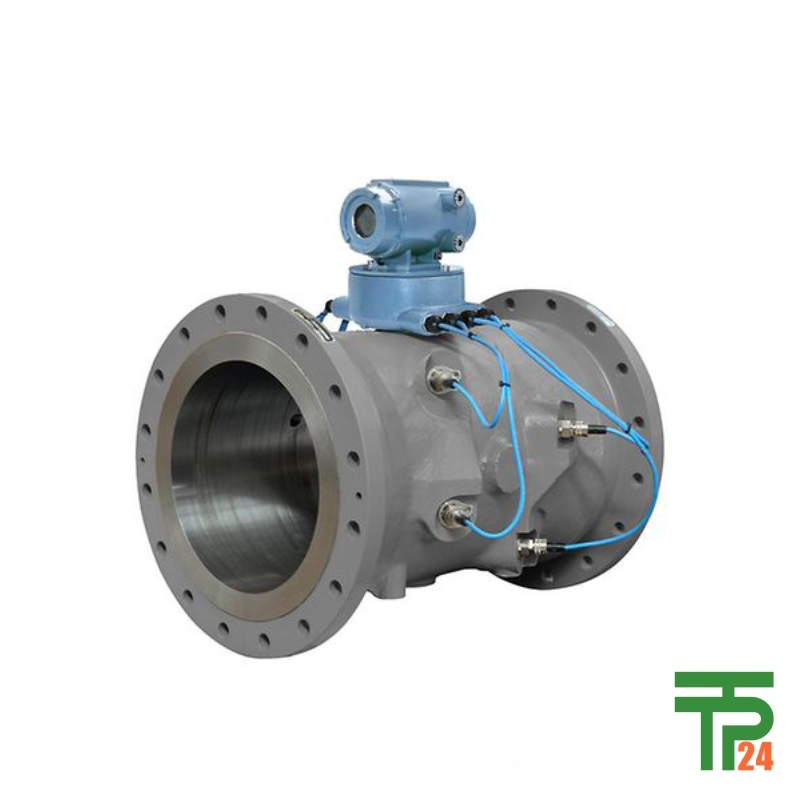
Rosemount™ 3814 Four-Path Liquid Ultrasonic Flow Meter
- Extend
Did you like this product? Add to favorites now and follow the product.

(+86) 132-6243-8118 Start Live Chat
Description
Rosemount™ 3814 Four-Path Liquid Ultrasonic Flow Meter
Four‑Path Innovation Advancing Liquid Flow Precision
The Rosemount™ 3814 Four‑Path Liquid Ultrasonic Flow Meter defines Emerson’s pinnacle of precision for fiscal and process measurement across liquid hydrocarbons. Developed specifically to comply with API Chapter 5.8 and OIML R117, this instrument represents the gold standard for custody transfer, blending operations, and refinery balance applications. Its symmetrical four‑path configuration measures flow velocity via distinct chordal angles, enabling full velocity profile analysis in turbulent regimes while eliminating swirl‑induced distortion. The 3814’s full‑bore, unobstructed passage virtually eliminates pressure drop, protecting pipeline integrity while reducing energy consumption in pump‑driven networks. Operators benefit from extremely low uncertainty < ± 0.027 % as verified under API MPMS certification procedures. This engineering excellence ensures that from refined fuels to heavy crude oils, measured data remains linear, repeatable, and trustworthy across the broadest flow range available in ultrasonic metering technology.
Superior Linearity Supported By Advanced Flow Electronics
Integral to the 3814 performance framework are the Rosemount 3810 Series Electronics, a state‑of‑the‑art platform designed for lightning‑fast acoustic sampling and dynamic flow state recognition. By capturing minute time‑of‑flight variances between its four ultrasonic paths, the electronics achieve remarkable linearity—±0.15 % within the standard 1.2 to 12.2 m/s (4 – 40 ft/s) velocity range. Optional configurations extend low‑end measurement stability down to 0.3 m/s (1 ft/s) without accuracy compromise. Operators use this responsiveness to detect changes in flow dynamics associated with viscosity variation or multiphase transition in heavy crude pipelines. The 3810 Series also calculates corrected mass rates and density‑adjusted volume outputs in real time, empowering operators to make precise reconciliations in fiscal transfer audits. In complex petrochemical blending facilities, these capabilities reduce measurement uncertainty to negligible levels and firmly support compliance with stringent international metrology standards.
Advanced Diagnostics Safeguarding Continuous Operational Integrity
Emerson equips the Rosemount 3814 with a comprehensive diagnostic suite that pre‑emptively flags anomalies within the process stream. Using MeterLink™ Software, technicians monitor flow symmetry, blockage probability, and transducer status from a unified graphical interface. Real‑time mapping of acoustic signal strength transforms the flow meter into a predictive maintenance instrument. Alerts for upstream obstruction or fouling allow immediate adjustments—avoiding production losses or expensive unplanned shutdowns. Additionally, built‑in Smart Meter Verification operates while the meter remains online, comparing current response signatures to baseline calibration data to confirm ongoing accuracy. This digital vigilance dramatically extends calibration intervals, reduces inspection workload, and ensures regulatory conformance. In sectors such as crude transfer terminals, refinery blending stations, chemical dosing manifolds, and marine offloading points, the 3814 functions as a guardian of measurement reliability and operational continuity.
Mechanical Design Strength Ensuring Field Longevity Worldwide
The mechanical resilience of the 3814 is achieved through robust construction in carbon steel or stainless steel, providing outstanding corrosion resistance under severe conditions. Rated for pressures up to 155 bar (2,250 psig) and temperatures to 150 °C (302 °F), this meter operates seamlessly in environments ranging from arctic pipelines to tropical tank farms. Its non‑wetted, field‑replaceable transducers simplify maintenance—technicians can service the meter without disturbing process integrity or depressurizing lines. The full‑bore design contains no moving parts, virtually eliminating wear and periodic calibration requirements except when locally mandated. Mechanical simplicity combines with acoustic precision to promote reliability for decades. These attributes make the 3814 ideal for installations demanding long‑term stability—such as strategic fuel storage tanks, aviation fuel distribution systems, and maritime bunkering stations—where downtime costs outweigh any initial equipment investment.
Dedicated Industrial Applications Across Energy Sectors
The adaptability of the Rosemount 3814 is reflected in its deployment across diverse industrial domains. Refineries employ it for product transfer accounting between process units. Pipeline operators depend on its accuracy for multi‑station flow balance calculation, mitigating inventory discrepancies. Petrochemical complexes integrate the 3814 for precise measurement of feedstock streams such as xylene, ethylene, and naphtha. In power generation, operators use it for turbine fuel control and efficiency audits to optimize combustion balance. Marine terminals adopt the meter to verify loading/unloading volumes of export-grade crude. Renewable fuel producers monitor sustainable biodiesel blends where viscosity fluctuates sharply with composition. Across these scenarios, the 3814’s acoustic symmetry, high frequency sampling, and rugged construction converge to deliver consistent metrological reliability—ensuring fiscal accuracy and industrial performance wherever liquid hydrocarbon flow must be quantified under international trade regulation.
Specifications
Related products



Fair Pricing, Guarantee of Authenticity and Quality, Fast Delivery, and Provision of Technical Support to Customers.
Copyright 2025 © TPT24 Company. All right reserved. Powered by TPT24.
