

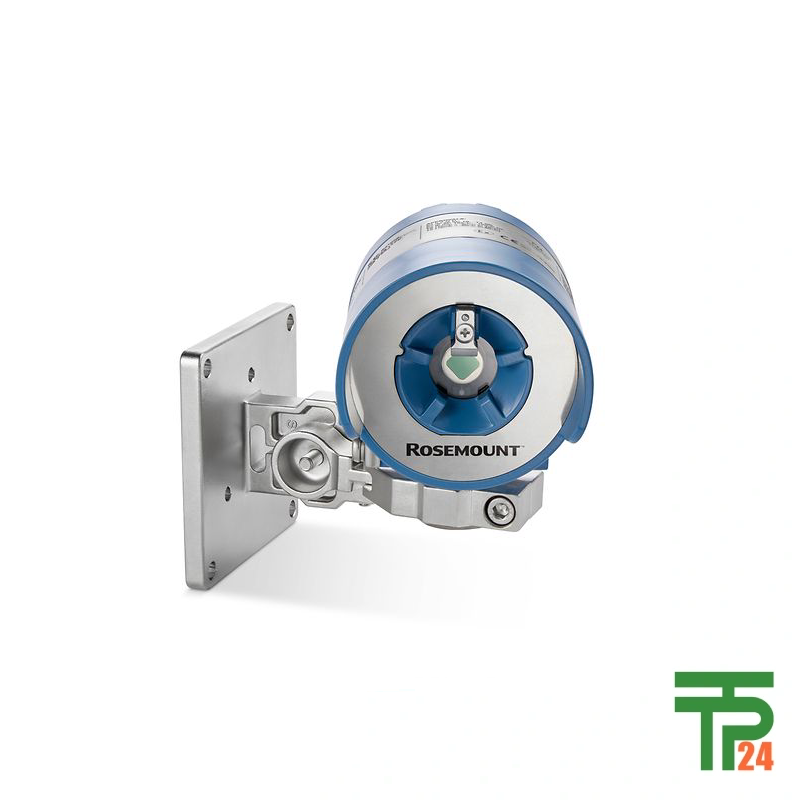
Rosemount™ 965 Flame Detector
- Four Infrared Spectral Bands
- Response Time Below Five Seconds
- Detection Range 150 Feet Maximum
- HART® And Modbus® Outputs
Did you like this product? Add to favorites now and follow the product.

(+86) 132-6243-8118 Start Live Chat
Description
QuadSense Infrared Technology Ensures Accurate Flame Detection
The Rosemount 965 Multi‑Spectrum Infrared Flame Detector represents Emerson’s most refined generation of optical fire‑safety engineering, designed for immediate, dependable detection of hydrocarbon gas and liquid fires through advanced QuadSense™ multi‑spectral IR technology. Within the spectral range of four infrared bands between 4 μm and 5 μm, the unit distinguishes flame radiation from non‑flame background sources with exceptional precision. By simultaneously comparing multiple frequencies of IR energy, the 965 verifies true combustion signatures while rejecting interference caused by sunlight, hot processes, or reflections—achieving remarkable immunity to false alarms. Its detection capability extends to 150 ft (45 m) at maximum sensitivity, with customizable settings across five selectable sensitivity levels, allowing optimal coverage for each environment. The versatile optical architecture yields a horizontal field of view of 100° and vertical 95° at half distance, guaranteeing broad visual coverage even within complex spatial layouts. Built for versatility and engineered for speed, this detector’s inherently robust software and optics harmonize instantaneous decision‑making with industrial‑grade dependability, securing protection for sites where rapid identification of fire onset is essential.
High Speed Response And Exceptional Stability Design
Speed in decision‑making defines genuine safety, and the Rosemount 965 delivers reaction times of less than five seconds—an impressive benchmark in optical flame recognition. The detection electronics evaluate spectral data continuously, triggering immediate alarms when verified combustion emissions appear. This responsiveness not only prevents damage propagation but also supports integration into emergency shutdown systems and suppression equipment. In parallel, advanced filtering algorithms minimize background noise from dust and temperature changes, ensuring stable performance over time. The 965 operates effectively within a temperature window of –40 °F to +158 °F (–40 °C to +70 °C), handling severe climatic and thermal extremes without sensor drift. Humidity tolerance up to 100 % non‑condensing extends functionality into offshore or tropical sectors where condensation regularly challenges electronic instruments. Factory calibration—performed by Emerson—renders the detector “calibrated for life use,” requiring no recurring adjustment during service. Continuous Built‑In Test (BIT) routines evaluate optical clarity and amplifier integrity, ensuring operational assurance for years of deployment. Combining responsiveness, self‑checking, and calibration permanence, the 965 establishes an enduring reliability standard for organizations needing immediate alarm verification under demanding industrial conditions.
Rugged Construction Guarantees Durability In Extreme Environments
Infrastructure protection demands instrumentation capable of resisting vibration, moisture, electromagnetic interference, and mechanical shock—areas where the Rosemount 965 excels. Emerson’s designers employ a 316L stainless‑steel housing, chosen for corrosion resistance and operational endurance across oil, gas, and chemical sites exposed to contaminants. Cable entry via one M20 conduit and electrical input protection in accordance with EN 50130 simplify secure connection while ensuring compliance with European safety norms. The detector features a compact architecture that facilitates mounting across control rooms, ventilation ducts, offshore decks, or helicopter landing zones where wind and vibration coexist. EMI and RFI shielding, certified under EN 61000‑6‑3, EN 61000‑6‑4, EN 61000‑6‑6, guarantee signal purity when installed adjacent to industrial motors or heavy rotating equipment. Mechanical sealing sustains full operation even under persistent dust and humidity cycles, maintaining optical window transparency throughout years of exposure. Furthermore, physical strength allows alignment precision within ± 0.5°, safeguarding accuracy against structural movement. Whether used within subterranean compressor chambers or exterior refinery pipe racks, the flame‑detector’s stainless robustness underpins operational continuity, prepared to endure every environmental challenge while maintaining responsiveness and calibration consistency across decades of service.
Intelligent Communication Supports Simplified System Integration
Modern facilities require smart integration with networked control architectures, an area mastered by the Rosemount 965, combining analog, digital, and serial communication streams for flexible connectivity. The 0–20 mA stepped signal output provides simple direct link to conventional fire panels—transmitting status values such as Fault (< 1.1 mA), Normal (4 mA), Warning (16 mA), and Alarm (20 mA)—while maintaining fail‑safe guidance even during line interruptions. Simultaneously, Emerson’s adoption of HART® protocol enables configuration changes, calibration verification, and maintenance diagnostics via frequency‑shift keying (FSK) directly along the analog loop—a function critical for predictive maintenance programs. For advanced installations governed by distributed control systems, the RS‑485 Modbus® interface connects multiple detectors in digital networks, providing central oversight through SCADA or asset‑management software. Relays integrated into the system provide SPST volt‑free contacts rated 2 A at 30 VDC, partitioned for separate fault and alarm circuits. User access is optimized through nine‑terminal electrical interface design, facilitating standardized wiring protocols across Emerson fire‑detection series. Each communication pathway enhances fluid configurability and redundancy, meaning that even vast industrial campuses can integrate the 965 into multimodal alarm networks with minimal adaptation effort while maintaining industry‑recognized communication integrity and compatibility.
Exclusive Application Scenarios Demonstrate Practical Versatility
The Rosemount 965 shines most clearly through its wide scope of specialized real‑world applications. Within oil and gas production facilities, the detector continuously monitors separation areas, compressor housings, and pipeline manifolds for early ignition cues from hydrocarbon leaks. In petrochemical processing plants, its high false‑alarm immunity protects units operating with radiant heaters or flares, successfully discriminating between standard process light and actual flame events. For aircraft hangars and fueling stations, the 965 covers large open volumes, instantly recognizing kerosene or jet‑fuel fires within 150 ft distance. Power generation sites harness its capabilities in turbine enclosures or transformer rooms to detect potential arc‑induced hydrocarbon fires. On marine platforms, the detector’s humidity endurance and stainless casing counter salt exposure while monitoring deck equipment for methane outgassing. In chemical warehouses, adjustable sensitivity adapts to ambient reflective conditions, ensuring reliable alarm differentiation in confined spaces. Even paint booths, solvent storage rooms, and sub‑surface utility tunnels exploit Emerson’s multiple sensitivity presets for adaptive monitoring under variable lighting. Across all these applications, the Rosemount 965 delivers robust, false‑free detection wherever energy, flammable materials, and human safety intersect—a universal solution capable of defending infrastructure from ignition risk through high‑speed verification under any scenario.
Advanced Diagnostic Functions And Operator Confidence Features
Beyond detection accuracy, the Rosemount 965 emphasizes continuous integrity verification and data confidence, empowering operators with real‑time performance transparency. The instrument’s Infrared Built‑In Test (BIT) operates in the background, constantly validating optical path integrity and circuit health without interrupting flame‑watching functions. A sophisticated event recorder stores alarm and system‑status logs for operational traceability—an essential safety‑audit component in industries adhering to ISO and IEC compliance frameworks. Multiple output options accommodate integration with analogue panels, digital controllers, or hybrid alarm systems, permitting retrofit onto legacy infrastructures without compatibility concerns. Universal wiring architecture and modular electronics simplify installation, accelerating commissioning time during plant construction or expansion. All electronics undergo rigorous factory acceptance tests under Emerson’s global QA routine before shipment, and each device includes two‑year warranty coverage, extendable according to project specification. The combination of BIT, logging, HART/Modbus intelligence, and durable design establishes an instrumentation platform that not only detects flames but continuously reassures operators that all safety channels remain active, monitored, and ready—delivering the assurance industries depend on when protecting personnel and equipment from combustible fire risk.
Specifications
Related products


Recently Viewed Products


Fair Pricing, Guarantee of Authenticity and Quality, Fast Delivery, and Provision of Technical Support to Customers.
Copyright 2025 © TPT24 Company. All right reserved. Powered by TPT24.
