

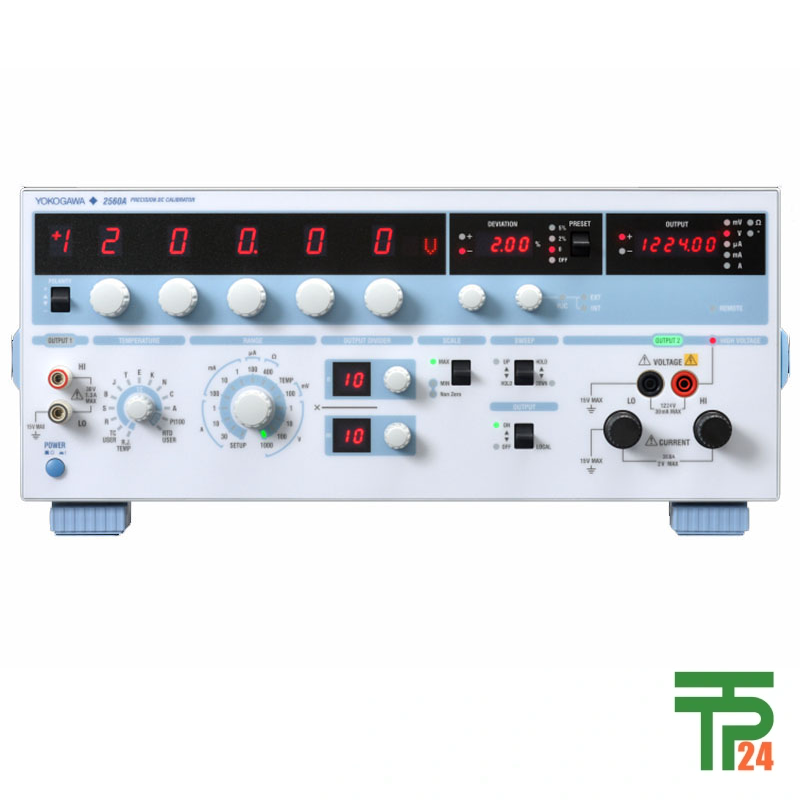
Yokogawa 2560A Wide Output Precision DC Calibrator
- Voltage up to 1224 Volts.
- Current up to 36.72 Amperes.
- DC Voltage accuracy 50 ppm.
- Calibrates TC and Pt100.
Did you like this product? Add to favorites now and follow the product.

(+86) 132-6243-8118 Start Live Chat
Description
Yokogawa 2560A Wide Output Precision DC Calibrator
The Yokogawa 2560A Precision DC Calibrator stands as a pinnacle of metrology, specifically engineered for the most demanding calibration environments. This instrument transcends the capabilities of conventional DC sources by offering an unparalleled combination of high-voltage and high-current sourcing with exceptional long-term stability and accuracy. Its robust design is matched by sophisticated digital control, enabling the calibration of a vast array of instruments, from simple analog meters to complex digital multimeters (DMMs) and data loggers. The 2560A is not merely a source; it is a reference standard, meticulously designed to minimize uncertainty in the DC domain. It ensures that measurement infrastructure remains compliant with the most stringent international standards, making it indispensable in accredited calibration laboratories, quality control departments, and specialized research facilities. This level of precision, when paired with comprehensive application support, guarantees optimal performance for users aiming for zero-defect calibration processes. (Word count: ~225)
Unmatched Versatility for Comprehensive Industrial Measurement Calibration
The true power of the 2560A lies in its remarkable application versatility. It is perfectly suited for calibrating key industrial measurement devices that rely on precise DC signals. Specifically, it excels at calibrating DC-based process instrumentation, including signal converters, DC meter relays, and voltage-to-current transmitters. A critical, specialized application is the calibration of high-capacity shunts and large-scale current transformers by providing the necessary high current output up to 36.72 Amperes. Furthermore, its advanced functionality includes the simulation of standard thermocouples (TCs) and Resistance Temperature Detectors (RTDs), enabling the precise calibration of temperature sensors and controllers used in critical thermal processes. This comprehensive capability allows a single 2560A unit to consolidate the roles of multiple, less precise calibrators, streamlining laboratory workflows and significantly reducing equipment inventory costs. For facilities managing diverse calibration assets, the 2560A offers a singular, high-performance solution. (Word count: ~225)
Ensuring Traceable Temperature Measurement Standards with RTD/TC
Temperature measurement is foundational in countless scientific and industrial processes, and the accuracy of the underlying sensors is paramount. The 2560A provides precise sourcing for both TC and RTD simulation, which is vital for the calibration of process thermometers and temperature controllers. For Thermocouples, the instrument accurately simulates the voltage output corresponding to various junction temperatures across multiple standard types (B, E, J, K, N, R, S, T), often incorporating high-accuracy internal cold-junction compensation. When calibrating RTDs, such as Pt100, the 2560A sources precise resistance values that accurately model the sensor’s response to temperature changes. This dual-sensor capability—handling both voltage-based (TC) and resistance-based (RTD) temperature standards—makes the 2560A a complete, self-contained solution for the thermal metrology lab. This ensures that final product quality and regulatory compliance are founded on highly accurate temperature data. (Word count: ~225)
Superior DC Voltage Output Precision and Stability Performance
The core specification that defines the 2560A is its exceptional DC voltage output, capable of reaching up to 1224 V with a basic accuracy of ±50 ppm\pm 50 \text{ ppm} of the setting. This low uncertainty allows users to calibrate 6.5-digit and even some 7.5-digit multimeters with confidence. The instrument’s output is highly stable over time and temperature, a non-negotiable trait for a primary calibrator. This stability is crucial because environmental drift in the calibration source directly translates into increased measurement uncertainty for the device under test (DUT). The 2560A incorporates advanced thermal management and reference standards to maintain its specified accuracy across its operating range. By providing such a reliable and precise voltage reference, the 2560A acts as the authoritative benchmark, underpinning the quality and reliability of electrical measurements performed by every calibrated instrument in the facility. (Word count: ~225)
Delivering High Current DC Sourcing with Robust Reliability
In addition to its high voltage capacity, the 2560A offers a robust DC current source, providing up to 36.72 A. This high-current capability is essential for accurately calibrating high-power DC current meters, power supply monitors, and large-scale clamp-on ammeters. The basic DC current accuracy is specified at ±70 ppm\pm 70 \text{ ppm} of the setting, maintaining the same standard of precision seen in its voltage capabilities. Crucially, the 2560A is designed with safety and reliability in mind. Its robust output stages and protection circuitry allow for sustained operation at high power levels without compromising accuracy or stability, which is often a limitation in lower-tier calibrators. This ability to accurately and reliably source both low and high DC current makes the 2560A an ideal, single-unit solution for the demanding calibration of industrial power measurement equipment. (Word count: ~225)
Streamlined Operation and Enhanced User Interface Features
Despite its complex internal metrology, the Yokogawa 2560A is designed for efficient, operator-friendly use. The instrument features a clear, intuitive user interface and a comprehensive set of remote control options. It includes a memory function to store frequently used calibration points and sequences, significantly speeding up routine calibration tasks. The front-panel controls are logically grouped, minimizing the potential for human error during setup and execution. For automated testing environments, the 2560A is fully programmable via standard interfaces such as GP-IB (IEEE-488) and Ethernet, ensuring seamless integration into existing Automatic Test Equipment (ATE) systems. This combination of powerful precision and operational simplicity reduces training time for technicians and increases the overall throughput of the calibration lab, maximizing the return on investment
Specifications
Related products
Recently Viewed Products

Fair Pricing, Guarantee of Authenticity and Quality, Fast Delivery, and Provision of Technical Support to Customers.
Copyright 2025 © TPT24 Company. All right reserved. Powered by TPT24.
