

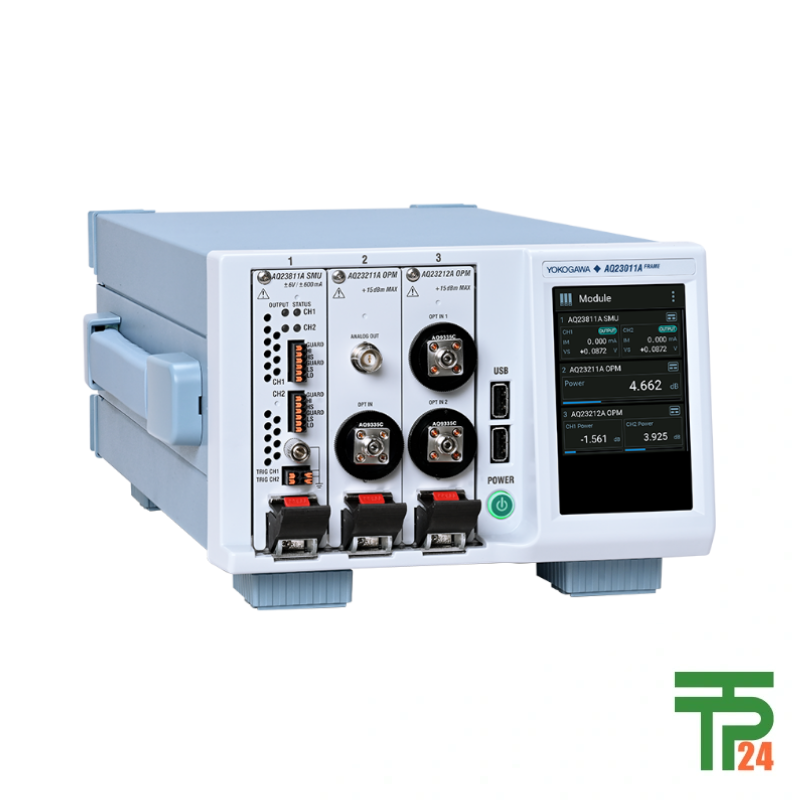
Yokogawa AQ2300 Series Test Platform
- Extend
Did you like this product? Add to favorites now and follow the product.

(+86) 132-6243-8118 Start Live Chat
Description
Yokogawa AQ2300: High-Speed Test Platform Evolution
The Yokogawa AQ2300 Series Manufacturing Test Platform represents a significant leap forward in automated optical and electrical measurement systems, specifically engineered to meet the stringent demands of modern high-speed component testing. Its architecture is intrinsically designed for massive parallelization and rapid data throughput, essential prerequisites for optimizing the complex characterization workflows inherent in Silicon Photonics (SiPh) and advanced semiconductor manufacturing. The fundamental strength of the AQ2300 lies in its modularity and processing backbone, which features significantly faster processing speeds than previous generations, directly translating to reduced cycle times in high-volume production environments. This enhanced performance is crucial when dealing with the intricate parameter mapping required for integrated photonic circuits, where minute thermal drifts and wavelength shifts must be logged and compensated for almost instantaneously. The system architecture supports flexible configurations, utilizing either compact 3-slot or scalable 9-slot mainframe chassis, providing engineers the flexibility to tailor the test bench footprint to specific application needs without compromising aggregate channel capacity. This scalability ensures that the AQ2300 remains a future-proof investment, capable of accommodating evolving device complexity and increasing throughput targets without requiring complete platform replacement. Furthermore, the platform’s capability to host an unprecedented density of measurement channels is a game-changer for simultaneous testing protocols, moving beyond sequential measurements to true parallel verification of multiple device functionalities.
Maximizing Efficiency Across Optical Fiber Testing
For the testing and qualification of optical fibers and bulk passive components, the AQ2300 platform delivers unparalleled measurement efficiency through its specialized module ecosystem. The integration of new, high-performance optical power meter modules is central to this capability, offering superior dynamic range and enhanced linearity across critical telecom and data center wavelengths (e.g., 1310 nm, 1550 nm, and emerging C+L bands). When performing stringent insertion loss or return loss testing on high-density fiber optic cables, the platform’s capability for high-speed data transfer ensures that raw measurements are moved from the module to the host processor with minimal latency. This rapid acquisition is particularly vital during automated quality control checks where hundreds of connection points must be validated per unit. Moreover, the platform intelligently manages complex test sequences involving pulsed light sources and detectors, ensuring synchronization accuracy down to the picosecond level across distributed channels. This precision is not merely beneficial; it is foundational for accurately characterizing dispersion limitations and polarization-dependent loss in specialty fibers used in sensing and high-bandwidth communications. The modular design allows system integrators to rapidly swap in specialized modules—such as Variable Optical Attenuators (VOAs) or tunable laser sources—directly into the mainframe, facilitating quick reconfiguration between different fiber qualification tasks without extensive external rack integration.
Semiconductor Device Validation Through Synchronization
The stringent testing requirements of modern semiconductors, particularly those incorporating integrated optical elements, necessitate absolute temporal correlation between electrical stimuli and optical responses. The AQ2300 addresses this by implementing advanced Stimulus Measurement Unit (SMU) synchronization capabilities that offer tight inter-channel timing control. This allows for the precise application of complex, high-speed voltage and current waveforms to the device under test (DUT) while simultaneously capturing the resulting optical emission or transmission characteristics. The ability to synchronize these discrete events across multiple channels is paramount for assessing the transient response of modulators, lasers, and detectors embedded within advanced IC packages. For example, characterizing the chirp parameter or extinction ratio under real-world operating conditions requires capturing I-V characteristics concurrently with optical output power modulation. The platform’s internal clocking system maintains exceptional phase accuracy, enabling measurement routines that were previously cumbersome, requiring external timing controllers. This internal coherence simplifies test setup and significantly reduces the potential for timing skew errors that plague less integrated solutions. Furthermore, the system’s memory architecture supports intensive logging; each channel is provisioned with up to 100k points of local storage, allowing extensive transient recordings to be captured before centralized processing, which is crucial for debugging rare, high-speed failure modes.
Engineering Breakthroughs in Passive Component Assessment
Passive components, while seemingly simple, require high-precision, high-throughput testing when integrated into volume manufacturing flows for 5G infrastructure and data center interconnects. The AQ2300 excels here due to its robust architecture supporting dense channel configurations, expandable up to 18 channels across two interconnected frames, enabling the parallel testing of large passive arrays, such as arrayed waveguide gratings (AWGs) or multiplexers/demultiplexers (MUX/DEMUX). Testing these components often involves sequential tuning of wavelengths or polarization states while monitoring insertion loss across all output ports. The speed of the AQ2300’s internal bus architecture ensures that these iterative adjustments and acquisitions occur rapidly, drastically compressing the time required for comprehensive spectral mapping. Hot-swappable modules are a vital feature in a manufacturing context; if a specific optical power meter module requires calibration or replacement, it can be exchanged in seconds without powering down the entire test system, maintaining continuous throughput for the remaining operational channels. This design philosophy minimizes downtime, directly impacting Mean Time Between Failures (MTBF) goals for production lines reliant on these optical building blocks.
High-Speed Data Transfer for Automated Production Lines
In modern, highly automated manufacturing environments, the bottleneck often shifts from measurement acquisition speed to data handling and reporting. The AQ2300 is engineered with high-speed data transfer protocols and optimized internal memory structures to mitigate this issue. The 100k points storage capacity per channel means that detailed, high-resolution measurement traces can be stored locally, minimizing the frequency of large data dumps over the external interface (e.g., Ethernet or specialized factory network links). When transfer is necessary, the platform employs high-throughput interfaces capable of moving large datasets—such as full calibration curves or transient stability logs—from the tester to the Manufacturing Execution System (MES) in milliseconds. This rapid feedback loop is indispensable for process control, allowing immediate alerts if component performance drifts outside acceptable statistical process control (SPC) limits. The platform’s software environment is tightly integrated to facilitate the creation of complex, multi-step test routines that leverage this high-speed data handling, enabling sophisticated pass/fail algorithms to execute locally before reporting the summary result to the MES, thereby reducing host computer overhead.
Silicon Photonics: Addressing Intricate Device Integration Challenges
Silicon Photonics technology demands test equipment capable of addressing optical and electrical interfacing on the same chip, often involving grating couplers that are highly sensitive to alignment and wavelength. The AQ2300’s flexibility in accommodating various high-precision optical input/output modules allows engineers to configure specialized fixtures that interface directly with wafer probers or device handlers. For R&D validation of new SiPh designs, the ability to execute complex swept-wavelength measurements while simultaneously monitoring the output of multiple integrated photodetectors is crucial. The fast processing core handles the computational load of transforming raw optical power readings into calibrated responsivity curves across the entire device bandwidth. Moreover, the robust SMU synchronization is critical for testing active SiPh elements like Mach-Zehnder interferometers (MZI), where precise control over electrode voltages dictates the phase shift. The platform’s capability to execute these fine-grained electrical adjustments under tight timing constraints validates the high-speed performance metrics required for next-generation optical transceivers.
Optical Communications Equipment Qualification Ecosystem
For the final assembly and functional validation of high-speed optical communications equipment—such as transponders, line cards, or active optical cables (AOCs)—the AQ2300 acts as the centralized diagnostic core. Testing equipment designed for 400G and 800G data rates requires tools that can simulate complex traffic patterns and verify FEC (Forward Error Correction) performance. The modularity permits the configuration of a comprehensive test bench where one slot might house a high-power broadband source for system margin testing, while another slot holds a precise power meter array for monitoring insertion loss across all active data lanes simultaneously. The overall system speed, driven by faster processing, allows for the execution of lengthy stress tests—such as temperature cycling profiles combined with maximum power loading—to be completed within production shift timelines. The AQ2300’s ability to manage numerous channels means that an entire multi-port transceiver module can be functionally verified in a single, streamlined test sequence, dramatically improving overall factory throughput metrics compared to legacy, single-channel test setups.
Specifications
Related products


Fair Pricing, Guarantee of Authenticity and Quality, Fast Delivery, and Provision of Technical Support to Customers.
Copyright 2025 © TPT24 Company. All right reserved. Powered by TPT24.
