

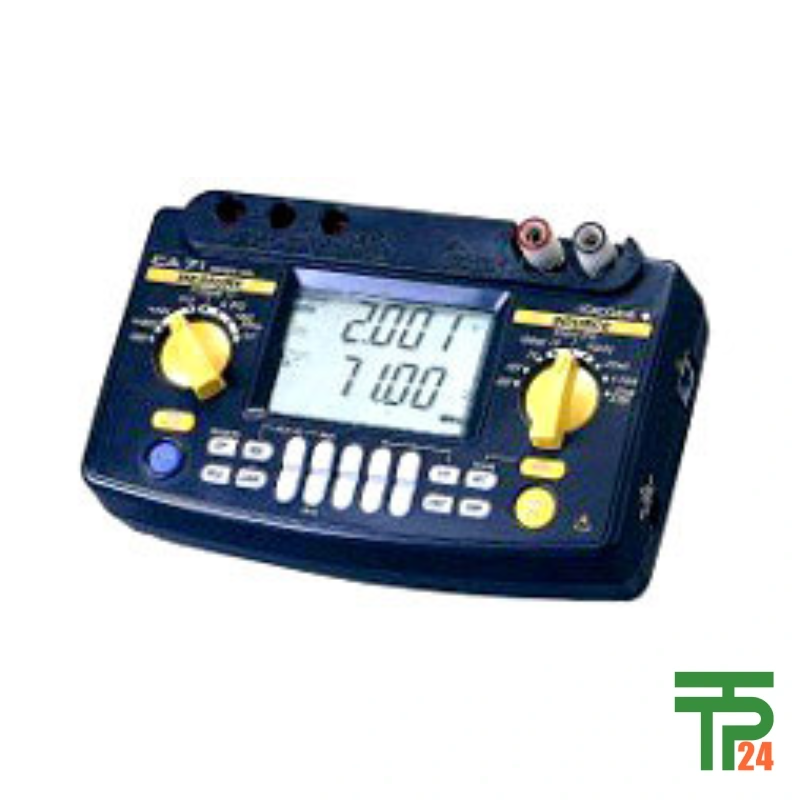
Yokogawa CA71 Multifunction Calibrator
- Measure/Source V, mA, R, TC, RTD.
- Auto-Step and Sweep functions included.
- Weight only 730 grams.
- Up to 40 hours battery life.
Did you like this product? Add to favorites now and follow the product.

(+86) 132-6243-8118 Start Live Chat
Description
Yokogawa CA71: The Ultimate Multi-Function Calibrator
The Revolutionary Handheld Calibrator for Field Engineers
The Yokogawa CA71 Handheld Multi-Function Calibrator stands as a prime example of precision instrumentation engineering, specifically designed to eliminate the need for field engineers to carry multiple, heavy pieces of equipment. This device provides an unparalleled integration of measurement and sourcing capabilities into one exceptionally lightweight and compact unit, tipping the scales at just 730 grams. The CA71 is simultaneously capable of sourcing signals while accurately measuring the corresponding output, making it an indispensable tool for routine maintenance, loop checks, and transmitter calibrations. Its true multifunctionality—covering Voltage (V), Current (mA), Resistance (Ω), Thermocouple (TC), Resistance Temperature Detector (RTD), Frequency (Hz), and Pulse—positions it as the single, definitive instrument for nearly all process instrumentation and automation needs. This comprehensive capability greatly simplifies field work, enhances efficiency, and ensures that technicians have the highest level of diagnostic power readily available. The seamless switching between measurement and sourcing functions, combined with its ergonomic design (190 x 120 x 55 mm), ensures optimal usability even in the most challenging industrial environments, representing a significant advancement over legacy single-function calibrators. The CA71 is engineered for the demanding world of industrial control, offering robustness and accuracy in a truly portable package.
Achieving Unprecedented Electrical Accuracy in Field Calibration
Operational precision in field calibrations is the determining factor for the accuracy of the final process, and the CA71 delivers dependable, high-fidelity performance in this area. The device functions expertly not only as a signal source but also as a highly accurate measuring instrument. In its sourcing capacity, the CA71 can generate and supply DC Voltage up to 30 V DC and DC Current up to 24 mA DC, covering all standard industrial process signals (0-10V, 4-20mA). Its measurement capability extends up to 100 V DC and 100 mA DC, allowing for versatile testing of control systems and I/O modules. Crucially, the CA71 boasts a base accuracy of 0.015% for DC current and voltage sourcing, providing the confidence required for critical tasks like verifying the linearity of transmitters. For modern instrumentation requiring precise signal simulation, the CA71’s ability to source and sink current, and its highly stable output, ensure that calibrations are performed to the strictest standards. Furthermore, it supports resistance simulation up to 400 Ω, vital for checking valve positioners and other resistive elements. The inclusion of 24V loop power capability means technicians do not need to carry a separate loop power supply, simplifying setup and reducing the complexity of loop checks. This dual-role capability—source and measure simultaneously—is performed through dedicated input/output terminals, allowing for true end-to-end loop integrity testing, a feature that drastically cuts down on troubleshooting time and improves overall maintenance quality.
Mastering Temperature Calibration with Multi-Sensor Support
One of the most powerful aspects of the CA71 is its versatility in the domain of temperature measurement and simulation. The device effectively operates as a high-precision Multi-Thermometer, offering comprehensive support for a vast array of temperature sensors essential in process control. This support encompasses all major Thermocouple types (TCs), including J, K, T, E, R, S, B, and N, ensuring compatibility across diverse industrial applications globally. Crucially, the CA71 integrates a built-in reference junction compensation sensor, which automatically corrects for ambient temperature variations at the terminal blocks, thereby maintaining high accuracy in TC measurements and simulations without requiring external ice baths or compensation devices. Beyond TCs, the CA71 provides robust support for common Resistance Temperature Detectors (RTDs), such as Pt100 (JIS/IEC), JPt100, and Pt50. The device can source and measure these signals with extremely fine resolution, allowing engineers to simulate a temperature range from cryogenic up to the limits of high-temperature sensors (e.g., Type B up to 1820°C). This extensive sensor compatibility ensures that the CA71 is ready for any temperature calibration task, from validating the setpoints of a process controller to troubleshooting faulty RTD inputs on a DCS system. By combining high precision and broad sensor support, the CA71 minimizes the need for specialized thermal calibrators, consolidating all temperature-related tasks into one powerful, ergonomic unit.
Smart Automation Functions for Optimized Calibration Routines
To streamline calibration processes that involve multiple test points, the Yokogawa CA71 offers a suite of intelligent automation functions that significantly reduce operational time and human error. The Auto-Step function allows the user to program the device to automatically increment the output (whether voltage, current, resistance, or temperature) across a specified number of steps (e.g., 5 steps for 0%, 25%, 50%, 75%, 100% calibration). The dwell time at each step is fully adjustable, enabling hands-free operation while the system settles and the reading is taken. Similarly, the Sweep function provides a smooth, continuous, and highly linear transition of the output signal from a starting value to an end value over a set period. This feature is particularly invaluable for testing the dynamic response and hysteresis of control valves and process controllers. Furthermore, the CA71 includes the n/m output function, which automatically generates an output value corresponding to a specific n/m step (e.g., 4/20 mA signal), eliminating the need for manual calculation of intermediate points. These powerful automation capabilities not only accelerate routine calibrations but also ensure high consistency and repeatability across all tests. By automating these repetitive, multi-point tasks, the CA71 allows technicians to focus on analysis and documentation rather than manual adjustment, leading to substantial time savings and higher quality field reports.
Robust Data Management and Traceability for Compliance
In today’s highly regulated industrial landscape, where accurate documentation and data traceability are paramount, the data management capabilities of the Yokogawa CA71 are exceptionally useful. The device is equipped with an internal Memory Function that allows the storage of up to 50 complete sets of calibration data. Each stored set includes the measured value, the sourced value, the date, and the time, providing a comprehensive audit trail of the calibration event. This feature is critical for compliance with quality standards like ISO 9001 and other regulatory requirements that mandate documented proof of periodic instrument calibration. By capturing data directly in the field, the CA71 dramatically reduces the risk of transcription errors that occur when manually logging measurements. The data can be easily reviewed on the large, clear display before being transferred. While the CA71 is designed for rugged field use, its internal data storage ensures that the integrity of the collected information is maintained until it can be uploaded or manually transcribed into a maintenance management system. For further integration and automation, the device also includes a Communication Function, allowing data transfer and remote control via its communication interface (adapter sold separately). This focus on secure, detailed data logging makes the CA71 an essential tool for maintaining the integrity of an organization’s instrumentation database and streamlining the creation of As-Found/As-Left calibration certificates.
Essential Applications: Transmitters, Controllers, and Safety Systems
The hardware and software versatility of the CA71 make it a multi-purpose instrument across all sectors of the process industries, including oil & gas, petrochemicals, pharmaceuticals, and power generation. Its primary and most frequent use is the calibration of transmitters and converters; the engineer can use the sourcing capability to input a simulated signal (temperature, pressure, or flow) into the transmitter’s input terminals while simultaneously measuring the resulting 4-20 mA output signal. This simultaneous source/measure capability allows for true linearity checks and precise range adjustments. Another critical application is the validation of control loops; by simulating the transmitter’s output signal, technicians can confirm the response of the control system (DCS or PLC) and ensure that the final control element, such as a valve or heater, reacts correctly to the simulated process variable. Furthermore, the CA71 is ideal for troubleshooting wiring faults and determining the location of signal degradation in long cable runs, thanks to its high-resolution measurement capability. The ability to simulate pulses and frequency signals (from 1 Hz to 11 kHz) also extends its utility to flowmeter calibration and testing speed-sensing devices. The lightweight design ensures it can be easily transported to high-elevation points or remote locations, making it the perfect companion for commissioning engineers and field service technicians who require maximum functionality with minimum bulk.
Specifications
| Auto-Step Output Function | n value sent automatically when n/m function selection is selected (two options: approximately 2.5 seconds/step or approximately 5 seconds/step) |
|---|---|
| Sweep Functions | Sweep time (two options: approximately 16 seconds or approximately 32 seconds) |
| Memory Function | 50 value sets (generated and measured values are stored as value sets with the same address (up to 50 value sets can be stored)) |
| Measuring Unit Maximum Input | Voltage terminal: 300 V AC Current terminal: 120 mA DC |
| Current Terminal Input Protection | Fuses: 125 mA/250 V |
| Measuring Unit Ground Voltage | Maximum 300 V AC |
| Measurement Display Updating Rate | Approximately once per second |
| Serial Interface | Enabled when communication cable (RS232) is connected; sold separately as optional accessory |
| Display | Segmented LCD (Approx. 76 mm × 48 mm) |
| Backlight | LED backlight; auto-off after one minute (from when LIGHT key is turned on) |
| Power Supply | Four AA alkaline batteries, or special AC adapter (sold separately) |
| Battery Life | Measurement off, output 5 V DC/10 kO or greater: Approximately 40 hours Simultaneous signal generation/measurement, output 5 V DC/10 kO or greater: Approximately 20 hoursSimultaneous signal generation/measurement, output 20 mA/5 V: Approximately 12 hours (using alkaline batteries, with backlight off) |
| Auto-Power-Off Function | Approx. 10 minutes (auto-power-off can be disabled through a DIP switch setting) |
| Applicable Standard | EN55011: 1998, Class B, Group 1 EN61326-1: 1997 + A1: 1998 IEC61010-1, IEC61010-2-31 |
| Insulation Resistance | Across input terminal and output terminal, 500 V DC, 50 MO or greater |
| Withstand Voltage | Across input terminal and output terminal, 3.7 kVAC, for one minute |
| Operating Temperature And Humidity Ranges | 0 – 50°C, 20 – 80% RH (no condensation) |
| Storage Temperature And Humidity Ranges | -20 – 50°C, 90% RH or less (no condensation) |
| External Dimensions | Approx. 190 × 120 × 55 mm |
| Weight | Approx. 730 g (including batteries) |
Related products


Recently Viewed Products

krohne Flow nozzle meter


Fair Pricing, Guarantee of Authenticity and Quality, Fast Delivery, and Provision of Technical Support to Customers.
Copyright 2025 © TPT24 Company. All right reserved. Powered by TPT24.
