

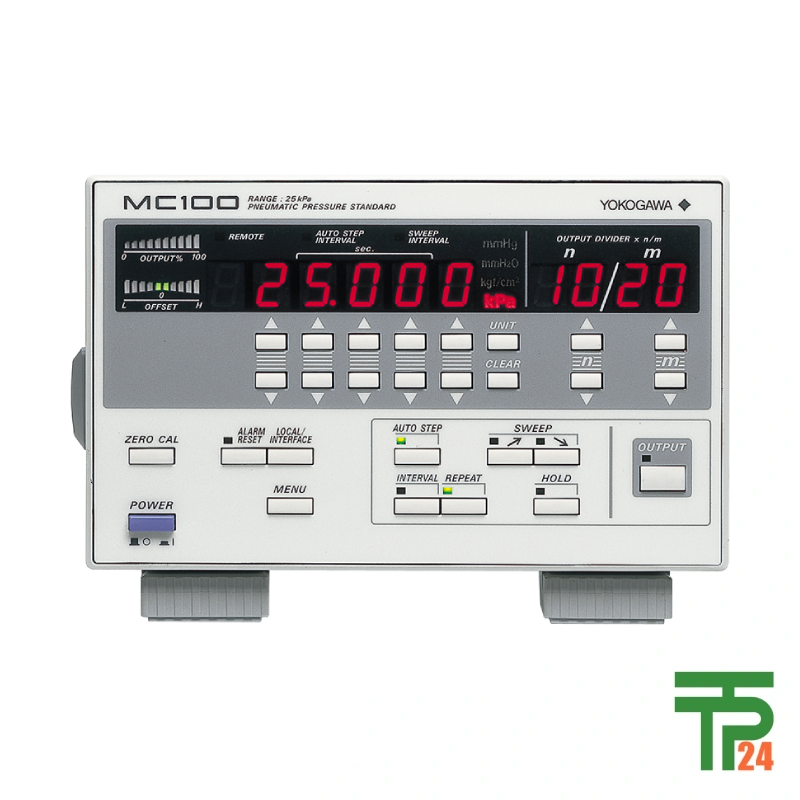
Yokogawa MC100 Pneumatic Pressure Standard
- 0.05% full scale accuracy.
- Silicon resonant sensor.
- Auto-step/sweep outputs.
- Extremely low temperature coefficient.
Did you like this product? Add to favorites now and follow the product.

(+86) 132-6243-8118 Start Live Chat
Description
Yokogawa MC100 Pneumatic Pressure Standard
The Yokogawa MC100 Series stands as a paramount solution in the exacting field of pressure instrumentation calibration and maintenance, addressing the relentless industry demands for superior accuracy amidst intense price competition. This sophisticated instrument series is engineered not merely to meet contemporary calibration benchmarks but to define new standards for reliability across a spectrum of pressure-sensing devices. From rugged industrial transmitters and high-volume pressure switches to sensitive medical apparatus like sphygmomanometers, the MC100 Series provides the traceable reference capability essential for quality assurance. Its fundamental design philosophy centers on delivering metrological performance that significantly outperforms conventional calibration tools, making it an indispensable asset for any laboratory or field service operation where precision is non-negotiable. The core technology driving this performance leap—the proprietary silicon resonant sensor—ensures that every reading is underpinned by fundamental physical constants, rather than drift-prone mechanical elements. This foundational excellence positions the MC100 as the transfer standard of choice for achieving CC-level comparability in international metrology forums and rigorous national accreditation schemes.
Paragraph 2: The Silicon Resonant Sensor: Unmatched Stability Foundation
At the heart of the MC100 Series’ exceptional performance lies its revolutionary silicon resonant sensor technology, a testament to Yokogawa’s mastery in micro-electromechanical systems (MEMS). This sensor utilizes two carefully isolated vibrators housed within a high-vacuum environment. This vacuum encapsulation is critical, as it drastically minimizes the dispersion of vibration energy, thereby enabling the achievement of an exceptionally high quality factor (Q value) when combined with the inherent flexibility of monocrystalline silicon. Pressure measurement is ingeniously derived not from the absolute frequency of a single element, but from the precise difference between the unique oscillation counts of the two vibrators. This differential measurement structure provides an inherent, powerful mechanism for canceling out most external environmental influences, most notably ambient temperature fluctuations and humidity ingress, which plague lesser sensors. The result is a sensor characterized by superior long-term stability, high sensitivity, and resolution that translates directly into quantifiable calibration confidence for the end-user.
Paragraph 3: Achieving Superior Accuracy With Low Thermal Dependence
The pursuit of high accuracy in pressure calibration is often undermined by thermal drift, yet the MC100 Series offers industry-leading resistance to these environmental variations. The design achieves an extremely low temperature coefficient, a specification vital for instruments intended for continuous use across varied operational temperatures. Specifically, the zero-point stability is maintained within ±0.003%\pm0.003\% of the full scale per degree Celsius (°C\text{°C}), while the span stability exhibits an even tighter drift of ±0.002%\pm0.002\% of the full scale per °C\text{°C}. This minimal thermal dependence ensures that a calibration performed in a controlled environment remains valid even when the unit is deployed in dynamic field settings. This level of thermal robustness significantly reduces recalibration frequency and minimizes the uncertainty budget associated with temperature gradients, solidifying the MC100’s role as a reliable primary reference instrument across diverse industrial sectors where temperature is a significant, unmanaged variable.
Paragraph 4: Advanced Output Functions For Automated Calibration Environments
Beyond mere static measurement accuracy, the MC100 Series is richly equipped with advanced digital output functions engineered to streamline and automate complex calibration routines. The instrument features a versatile Divided Output Function, capable of segmenting the measurement range into as many as 20 discrete, configurable steps. This is complemented by the sophisticated Auto-Step Output Function, which allows for the systematic stepping across the calibration curve without continuous manual intervention. Furthermore, the Sweep Output Function enables the user to smoothly transition the output across the entire range, simulating dynamic changes encountered in real-world process conditions. To further enhance troubleshooting and verification, the dedicated Offset Monitor Function provides immediate, on-screen presentation of any deviation between the actual output and the programmed final value, offering immediate feedback on calibration linearity and response time validation.
Paragraph 5: Specialized Applications In Emerging High-Tech Sectors
While the MC100 is proficient in general instrumentation calibration, its specific precision and stability make it uniquely suited for specialized, high-stakes applications driving modern technological advancement. A particularly critical application resides within the development and manufacturing of Electric Vehicles (EVs). Here, the MC100 is deployed to conduct highly accurate differential pressure (ΔP\Delta \text{P}) measurements across the intricate fluid pathways of thermal management systems. Monitoring the ΔP\Delta \text{P} across cooling loops for batteries, high-power inverters, and motors is paramount; any significant deviation from the nominal pressure drop can indicate flow restriction, blockage, or pump inefficiency, leading directly to thermal runaway or reduced component lifespan. The MC100’s ability to accurately measure ΔP\Delta \text{P} with the inherent ±0.05%\pm 0.05\% accuracy ensures that these critical cooling metrics are captured with the necessary rigor, making it an essential tool in the EV validation lifecycle and quality control gates.
Paragraph 6: Versatility In Measurement Media And Operational Flexibility
The design versatility of the MC100 extends to its compatibility with various pressure media and operational modes. The instrument is certified for the measurement of both low-pressure liquids and gases, provided they conform to safety standards (i.e., non-flammable, non-explosive, non-corrosive media as per Directive 2014/68/EC Article 13(1)(a)). This broad suitability ensures its utility across diverse manufacturing and utility environments. Moreover, the instrument offers operational flexibility through its unique capability to act as a single-unit differential pressure measurement device, simplifying setups where two separate pressure sources must be monitored relative to each other. For field service technicians, the optional, high-capacity Lithium-Ion battery pack provides up to six hours of crucial cordless operation, liberating the calibrator from fixed power sources and enhancing productivity during on-site verification of field-installed sensors and transmitters.
Specifications
Related products

Recently Viewed Products
Yokogawa 2792A Standard Resistors


Fair Pricing, Guarantee of Authenticity and Quality, Fast Delivery, and Provision of Technical Support to Customers.
Copyright 2025 © TPT24 Company. All right reserved. Powered by TPT24.
