

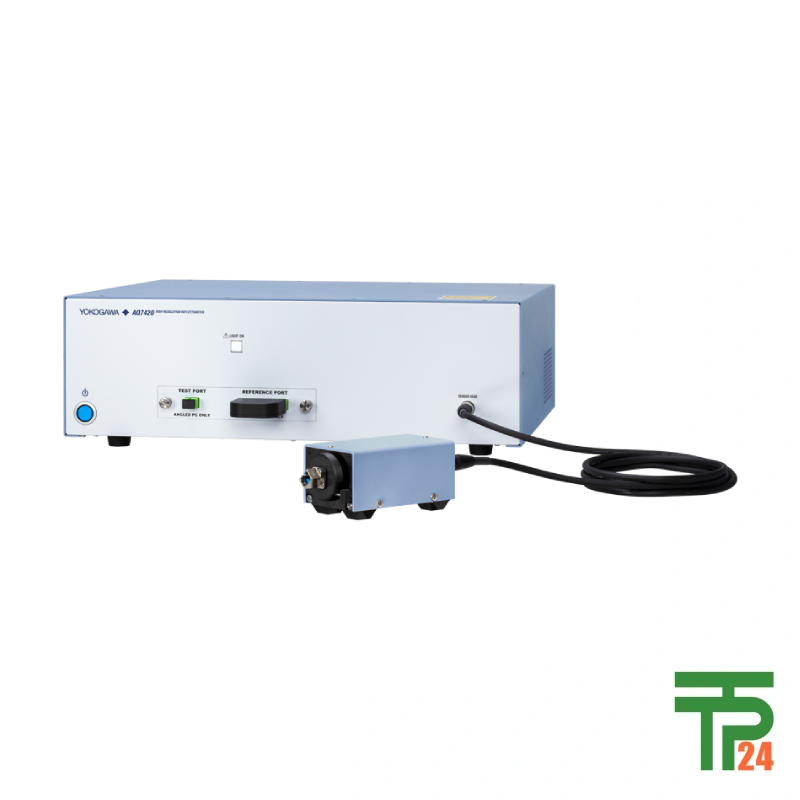
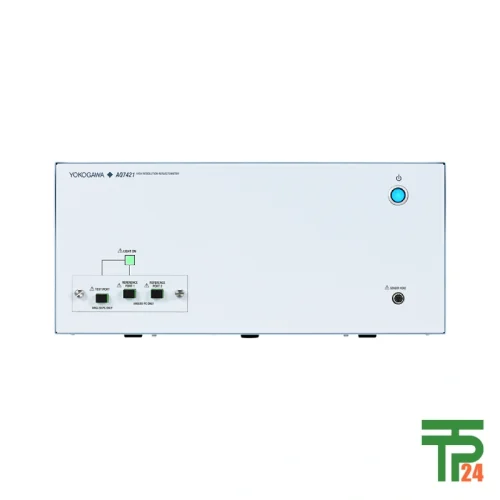
Yokogawa AQ7420 High-Resolution Reflectometer
- 40 μm spatial resolution
- 100 mm measurement range
- $\le -100 \text{ dB}$ spurious noise
- Simultaneous IL/reflection measurement
Did you like this product? Add to favorites now and follow the product.

(+86) 132-6243-8118 Start Live Chat
Description
AQ7420: Optical Component Analyzer for Precision Testing
The Yokogawa AQ7420 Optical Component Analyzer (OCA) stands as the zenith of optical testing technology, setting a new benchmark for the characterization and quality assurance of passive and active optical components. Designed for engineers demanding the highest fidelity data, the AQ7420 moves beyond the limitations inherent in traditional Optical Time Domain Reflectometry (OTDR) and Optical Component Reflectometry (OCWR) methods. Its core strength lies in its proprietary measurement engine, which provides unprecedented spatial resolution capable of discerning minute structural anomalies invisible to lesser instruments. We are not just measuring power loss; we are mapping the physical integrity of your most critical optical assets. This advanced capability ensures that every splice, connector, and integrated optical circuit meets stringent operational tolerances, making it indispensable for next-generation telecommunications, LiDAR systems, and high-density photonic integration. The superior dynamic range and advanced signal processing algorithms employed by the AQ7420 translate directly into actionable data, minimizing false positives and accelerating design validation cycles across the board.
Detecting Subtle Flaws: Microcrack Identification
A critical differentiator for the AQ7420 is its unparalleled sensitivity in defect detection, specifically targeting microscopic structural imperfections that severely impact long-term reliability. Microcracks, often invisible under standard inspection protocols, represent potential catastrophic failure points, especially when components are subjected to environmental stress such as thermal cycling or mechanical vibration. The AQ7420 utilizes an advanced coherence scanning technique, allowing for spatial resolution down to an astonishing 40 μm. This fine resolution permits the definitive identification and mapping of these sub-micron flaws within fiber end-faces, complex array connectors, and multi-mode waveguides. By accurately quantifying the localized reflectivity associated with these microcracks, engineers can establish robust quality gates, preventing the deployment of components destined for premature failure. This level of granular analysis is crucial for high-reliability applications, such as deep-sea cables or space-based optical links where manual inspection is impractical or impossible post-deployment.
Suppressing Noise for Pristine Measurements
In high-sensitivity optical testing, the presence of spurious noise is the enemy of accurate measurement. The Yokogawa AQ7420 has been engineered with state-of-the-art noise suppression technology, ensuring signal clarity even when analyzing highly reflective or highly lossy interfaces. This system achieves a remarkable spurious noise floor specification of $\le -100 \text{ dB}$. This exceptionally low noise floor is critical when measuring low-reflectivity features near high-reflectivity events, preventing the noise floor from masking subtle deviations in the component response curve. For instance, when characterizing an index-matching gel interface or a very low-loss planar waveguide section, the ability to maintain a quiet baseline ensures that measured insertion loss and reflection profiles are true representations of the device under test, rather than artifacts of instrumentation limitations. This inherent quietness elevates the AQ7420 above conventional reflectometers, providing confidence in data integrity across the entire measurement span.
Superiority Over Legacy Reflectometry Techniques
The architecture of the AQ7420 fundamentally surpasses the limitations traditionally associated with basic OFDR or OCWR systems. While older instruments often rely on simpler backscatter analysis, the OCA employs a sophisticated distributed measurement model that compensates actively for source instability, polarization fluctuations, and non-linear effects within the optical path. This results in measurement uncertainty that is significantly lower than legacy systems, particularly concerning insertion loss (IL) measurement accuracy. The result is a substantial improvement in measurement certainty, which is vital when performing pass/fail testing on components where tolerances are measured in hundredths of a decibel. The advanced algorithms inherent in the AQ7420 maintain calibration stability over extended operational periods, reducing the need for frequent re-zeroing, thereby enhancing throughput in high-volume testing environments.
Simultaneous Measurement: Efficiency Redefined
Efficiency in the laboratory and on the production floor is paramount. The AQ7420 is architected to execute simultaneous reflection and Insertion Loss (IL) measurements, a capability that dramatically streamlines testing protocols. Instead of requiring sequential measurements—one for reflection characteristics (like return loss) and another for transmission characteristics (IL)—the AQ7420 captures both domains concurrently. This dual-mode operation is supported by an extremely high accuracy specification for IL, boasting an uncertainty of just $\pm 0.02 \text{ dB}$. This integration means that a single sweep provides a complete signature of the component’s performance—its coupling efficiency and its back-reflection characteristics—all referenced to the same temporal and spatial coordinates. This simultaneous acquisition ensures data consistency between the two critical performance metrics, eliminating potential errors introduced by component repositioning or drift between separate tests.
Diverse Applications: From R&D to Mass Production
The versatility of the Yokogawa AQ7420 ensures its utility spans the entire product lifecycle. In Research and Development (R&D), its high spatial resolution and low noise floor are invaluable for characterizing novel waveguide geometries, optimizing fusion splice techniques, and developing new material interfaces where fundamental physical phenomena must be precisely quantified. Furthermore, the AQ7420 is a cornerstone for reliability testing. Components designated for harsh environments can be subjected to accelerated stress testing (e.g., high-temperature exposure) while continuously monitored by the OCA to detect degradation pathways—such as bond failure or material migration—long before they become macroscopic issues. In high-volume production, the speed and reliability of the simultaneous measurement mode translate into reduced cycle times and guaranteed quality control conformance for every unit shipped.
Specifications
Related products
Recently Viewed Products


Fair Pricing, Guarantee of Authenticity and Quality, Fast Delivery, and Provision of Technical Support to Customers.
Copyright 2025 © TPT24 Company. All right reserved. Powered by TPT24.
