
Fluke Electrical Testing Tools: 6 Best Solutions for Safety
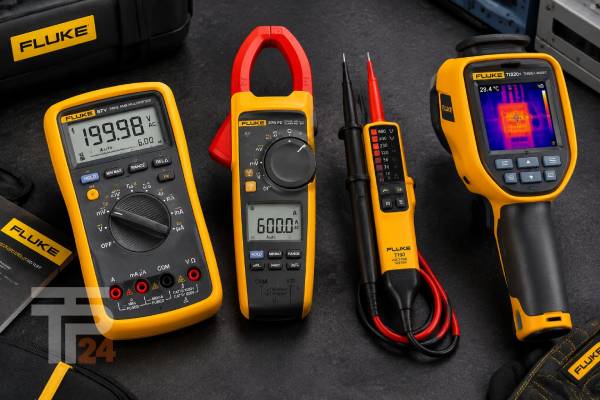
High-voltage power distribution networks, automated machinery, and commercial electrical panels demand uncompromising safety and exact measurement precision. Using certified Fluke electrical testing tools enables field electricians, electrical engineers, and reliability specialists to detect hidden faults, diagnose non-linear power anomalies, and protect personnel against arc-flash explosions. Whether you perform routine continuity checks or complex motor drive diagnostics, Fluke instruments deliver unmatched durability in harsh industrial operating conditions.
At TPT24, we supply authentic Fluke diagnostic instruments and calibration equipment to commercial clients globally. Below is our in-depth engineering breakdown of the primary Fluke electrical testing tools, their certified safety standards, and practical selection criteria for your maintenance operations.
Why Industrial Safety Relies on Fluke Electrical Testing Tools
Electrical testing carries inherent dangers from transient voltage spikes caused by lightning strikes, utility switching, and inductive load disconnections. The International Electrotechnical Commission (IEC) standard 61010 dictates rigorous overvoltage installation categories: CAT II, CAT III, and CAT IV. Premium Fluke electrical testing tools are engineered with patented blast-shield barriers, high-rupture-capacity (HRC) ceramic fuses, and input protection circuits capable of absorbing unexpected surges exceeding 8,000 volts.
Furthermore, modern industrial environments feature variable frequency drives (VFDs), uninterruptible power supplies (UPS), and solid-state LED systems that generate heavily distorted electrical waveforms. Standard averaging meters can register inaccurate readings by up to 40% in these conditions. True-RMS Fluke electrical testing tools accurately compute the effective heating value of complex AC waveforms, providing dependable metrics for load balance, neutral line overheating, and power quality compliance.
The 6 Essential Families of Fluke Electrical Testing Tools
Fluke designs distinct tool categories tailored to specific diagnostic tasks in electrical troubleshooting:
1. True-RMS Digital Multimeters (DMMs)
Handheld multimeters remain the primary diagnostic tool in every electrical technician’s tool bag. Compact models like the Fluke 106 offer 6,000-count resolution for tight control panels, while the rugged Fluke 117 incorporates VoltAlert™ non-contact voltage detection and LoZ low input impedance to eliminate false ghost voltages. For advanced automotive and high-voltage machinery, the Fluke 233A features a patented detachable wireless magnetic display, allowing technicians to view readings up to 30 feet away from hazardous live conductors.
2. Non-Contact Voltage and OpenJaw™ Electrical Testers
Speed and rapid verification are essential before contacting any physical circuit. The Fluke T5-600 and T6 series feature patented FieldSense™ and OpenJaw™ technology, letting technicians measure AC current up to 100A or 200A without opening the circuit or exposing live conductors. For immediate two-pole testing, the Fluke T110 provides dual-probe visual, audible, and tactile vibration alerts to confirm power absence even when working with heavy safety gloves.
3. Industrial Clamp Meters
When measuring high continuous current without interrupting facility operations, Fluke clamp meters lead the industry. Models like the Fluke 376 FC and 325 measure AC/DC current up to 1,000A, and incorporate the flexible iFlex® probe to wrap effortlessly around crowded bundles and oversized busbars in switchboards. Integrated low-pass filters filter out high-frequency drive noise to reveal the true operating current drawn by electric motors.
4. Insulation and Megohmmeter Testers
Degraded conductor insulation causes ground faults, phase-to-phase shorts, and motor winding failure. Instruments such as the Fluke 1507 and Fluke 1587 FC combine the full utility of a digital multimeter with high-voltage insulation resistance testing up to 1,000V DC. These specialized Fluke electrical testing tools calculate Dielectric Absorption Ratio (DAR) and Polarization Index (PI) automatically, highlighting long-term insulation breakdown before catastrophic outages occur.
5. Earth Ground and Earth Resistance Testers
Reliable grounding paths are mandatory to channel lightning strikes and overvoltage transients safely into the earth. Fluke earth ground testers, including clamp-on earth ground meters like the Fluke 1630-2 FC, measure ground loop resistance without requiring auxiliary ground stakes or disconnecting the grounding rod from the facility electrical system.
6. Power Quality Analyzers and Loggers
Voltage sags, harmonic distortions, phase unbalance, and power factor penalties significantly reduce electrical efficiency. Fluke three-phase power quality loggers capture transient anomalies over days or weeks, generating automated reports compliant with IEEE 519 standards and identifying the origin of intermittent equipment resets.
Technical Specifications: Comparing Fluke Electrical Testing Tools
The table below summarizes key specifications, safety ratings, and ideal deployment scenarios across leading Fluke electrical testing tools available at TPT24:
| Model Series | Primary Function | Measurement Range | IEC Safety Rating | Best Industrial Use Case |
|---|---|---|---|---|
| Fluke 117 | True-RMS Digital Multimeter | 600 V AC/DC, 10 A, LoZ mode | CAT III 600 V | Commercial facility electricians & HVAC diagnostics |
| Fluke 233A | Wireless Remote Display DMM | 1,000 V AC/DC, 10 A, Capacitance | CAT IV 600 V / CAT III 1,000 V | Confined spaces, automotive rigs & switchgear |
| Fluke T110 | Two-Pole Voltage Tester | 12 V to 690 V AC/DC, Continuity | CAT IV 600 V / CAT III 690 V | Rapid live/dead verification in distribution panels |
| Fluke T5-600 | OpenJaw™ Current/Voltage Tester | 600 V AC/DC, 100 A AC current | CAT III 600 V | Branch circuit checking & quick field diagnostics |
| Fluke 1587 FC | 2-in-1 Insulation Multimeter | 0.01 MΩ to 2 GΩ, 1,000 V test | CAT IV 600 V / CAT III 1,000 V | Predictive maintenance on motors, pumps & cables |
| Fluke 376 FC | True-RMS AC/DC Clamp Meter | Up to 1,000 A (2,500 A with iFlex) | CAT IV 600 V / CAT III 1,000 V | Heavy industrial switchgear & large electric motors |
Buying Guide: How to Select the Ideal Fluke Instrument
Choosing the correct device among various Fluke electrical testing tools requires reviewing specific operational criteria:
- Match Overvoltage Category to Location: Always verify whether testing occurs at the service entrance (requires CAT IV) or within downstream branch distribution panels (requires CAT III). Never use an instrument with an insufficient CAT rating on high-energy switchgear.
- Evaluate True-RMS Necessity: If your facility operates Variable Frequency Drives (VFDs), computers, or electronic ballasts, non-RMS meters produce severe calculation errors. Always insist on True-RMS Fluke electrical testing tools for accurate load balancing.
- Consider Wireless Logging Features: Instruments supporting the Fluke Connect™ mobile ecosystem transmit real-time data wirelessly to smartphones and cloud servers. This feature lets technicians share thermal and electrical data with remote engineering teams while standing safely outside the arc-flash blast perimeter.
- Verify Sourcing and Calibration Authenticity: Because life-safety decisions depend on test tool readings, avoid gray-market or counterfeit items. Procurement through certified international suppliers like TPT24 ensures original factory warranties, calibrated precision, and authentic manufacturer accessories.

Industrial Instrumentation Supplier
Fair Pricing, Guarantee of Authenticity and Quality, Fast Delivery, and Provision of Technical Support to Customers.
Copyright 2025 © TPT24 Company. All right reserved. Powered by TPT24.

