

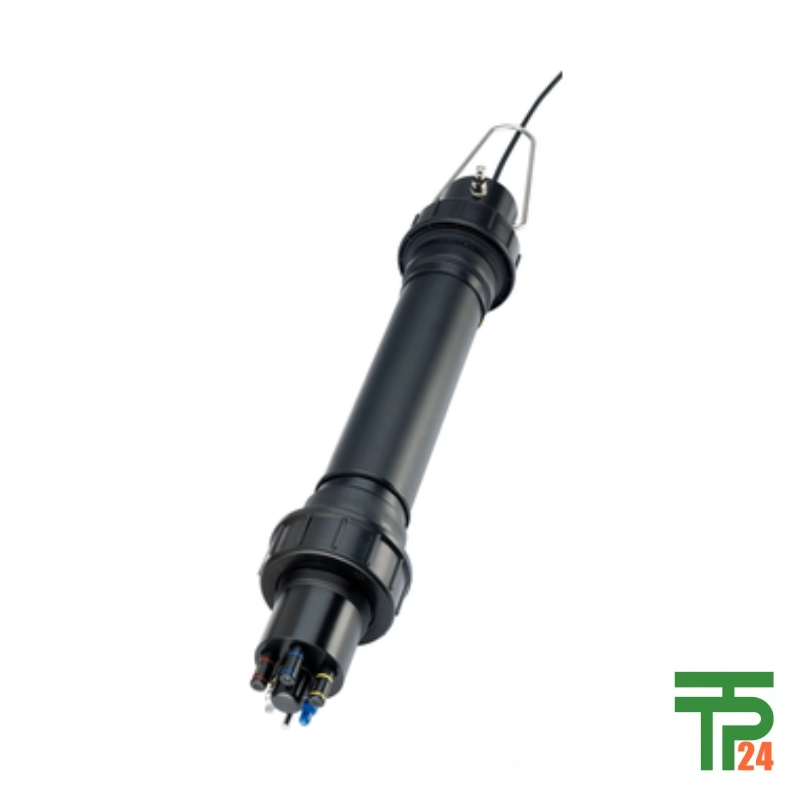
Endress+hauser CAS40D Digital ammonium and nitrate sensor ISEmax
- Measurement Principle: Potentiometric / ISE
- Primary Use: Nutrient Trend Measurement
- Maintenance: Low, Auto Flushing Unit
- Sensor Data: Stored Digitally (Memosens)
Did you like this product? Add to favorites now and follow the product.

(+86) 132-6243-8118 Start Live Chat
Description
Endress+Hauser CAS40D: Precision Nutrient Monitoring Excellence
Optimizing Aeration with Direct Measurement
The Endress+Hauser CAS40D, a state-of-the-art ion-selective sensor, is engineered for the precise trend measurement of critical nutrient parameters directly within wastewater treatment basins. Its primary function is to significantly enhance the efficiency of aeration processes, a major consumer of energy in these plants. By providing real-time data on ammonium and nitrate concentrations, the CAS40D empowers operators to fine-tune aeration levels, leading to substantial reductions in energy costs. Furthermore, the sensor operates without the need for expensive reagents, contributing to further cost savings and simplifying operational logistics. The robust design, featuring ion-selective membranes with excellent self-cleaning properties, minimizes maintenance requirements, allowing for more uptime and less manual intervention. Integrated with Memosens technology, the CAS40D ensures maximum process and data integrity, coupled with superior operating comfort and simplified predictive maintenance strategies.
Specific Applications in Wastewater Environments
The ISEmax CAS40D sensor is specifically designed for high-impact applications within municipal wastewater treatment plants, focusing on optimizing essential treatment stages. A key application is its direct installation within aeration basins. Here, it meticulously determines ammonium and nitrate concentrations, providing vital data for the effective control and regulation of ammonium decomposition processes. This real-time insight allows for load-dependent aeration control, a sophisticated method for optimizing the entire biological treatment process, ensuring efficient nutrient removal while minimizing energy consumption. Another critical application is at the inlet of aeration basins, where the CAS40D accurately determines the ammonium load, with pH compensation ensuring reliable readings even with fluctuating pH levels. This detailed understanding of influent characteristics is crucial for managing the treatment process effectively and preventing system imbalances, directly contributing to improved effluent quality and operational stability.
Key Benefits for Enhanced Treatment Efficiency
The CAS40D sensor offers a suite of compelling benefits that directly translate to improved operational efficiency and reliability in wastewater treatment. A standout advantage is its capability to measure nitrate and ammonium directly within the process stream, eliminating the need for costly and complex sample conditioning systems. This direct measurement approach significantly reduces equipment overhead and simplifies the overall monitoring setup. For enhanced accuracy, the sensor offers an optional potassium and/or chloride measurement. These additional measurements help compensate for potential cross-sensitivities, ensuring that the ammonium and nitrate readings are exceptionally reliable and accurate, even in challenging water matrices. The inclusion of an automatic flushing unit further minimizes maintenance requirements, automating a key task and ensuring continuous, uninterrupted operation, thereby boosting overall plant performance and reducing manual labor.
Robust Design for Reliable Process Integration
The physical design and installation flexibility of the CAS40D contribute significantly to its reliability and ease of use in demanding wastewater environments. The sensor is designed for direct installation on the basin rim, eliminating the need for separate measuring containers or sample-conveying pumps. This direct immersion approach simplifies the installation process, reduces potential points of failure associated with sample transport, and ensures that measurements are taken directly from the active process. The sensor’s robust construction, featuring durable ion-selective membranes, is built to withstand the harsh conditions typically found in wastewater treatment basins. This inherent resilience ensures long-term performance and consistent measurement accuracy, even in the presence of suspended solids or aggressive chemical conditions, making it a dependable choice for critical applications.
Memosens Technology for Data and Process Integrity
At the heart of the CAS40D’s advanced functionality is its integration with Memosens digital sensor technology. This innovative system ensures maximum process and data integrity by storing all sensor-specific data directly within the sensor head. This includes calibration data, operating hours, and other crucial diagnostic information. When it’s time for maintenance or recalibration, the sensor can be easily removed from the process and connected to a Memosens lab station or transferred to another Memosens-enabled transmitter. This seamless data transfer and storage capability simplifies maintenance tasks, ensures accurate calibration, and enhances overall operating comfort. By maintaining a digital record, Memosens technology also aids in predictive maintenance, allowing for proactive identification of potential issues before they impact the process, thereby guaranteeing reliable performance.
Measuring Principle and Comprehensive Sensor Configuration
The CAS40D operates on the potentiometric measurement principle, utilizing ion-selective electrodes (ISE) to accurately determine nutrient concentrations. This method is well-suited for continuous online monitoring of key parameters like ammonium and nitrate in municipal wastewater treatment plants. The comprehensive sensor configuration includes dedicated ion-selective electrodes for ammonium and/or nitrate, along with a reference electrode and a pH electrode. Additionally, it incorporates an ion-selective electrode specifically for compensating cross-interference, typically from potassium or chloride ions, which can affect the accuracy of ammonium and nitrate measurements. A built-in temperature sensor ensures that all readings are accurately compensated for temperature variations, further enhancing the precision and reliability of the analytical data provided by the system.
Specifications
-
Measuring principle
Potentiometric / ISE
-
Characteristic
Online measurement of nutrient parameters in
municipal wastewater treatment plants
Ion-selective electrode system for the continuous measurement of
ammonium and nitrate -
Size
Diameter: 112 mm (4.41 inch)
Immersion depth: 510mm (20.08 inch) -
Design
Ion-selective electrode(s) for ammonium and/or nitrate, potassium or chloride
pH – (Reference) electrode
Ion-selective electrode for compensating cross-interference
Temperature sensor -
Process temperature
2 °C to 40°C (36 to 100 °F)
-
Ambient temperature
-20 °C to 50 °C (-4 to 120 °F)
-
Process pressure
400 mbar (160 in H2O) max. permitted overpressure
-
Application
Wastewater treatment plants
-
Measuring range
Ammonium:
0.1 to 1000 mg/l (NH4-N)
Nitrate:
0.1 to 1000 mg/l (NO3-N)
Potassium:
1 to 1000 mg/l
Chloride:
1 to 1000 mg/l
Related products
Recently Viewed Products

Fair Pricing, Guarantee of Authenticity and Quality, Fast Delivery, and Provision of Technical Support to Customers.
Copyright 2025 © TPT24 Company. All right reserved. Powered by TPT24.
