

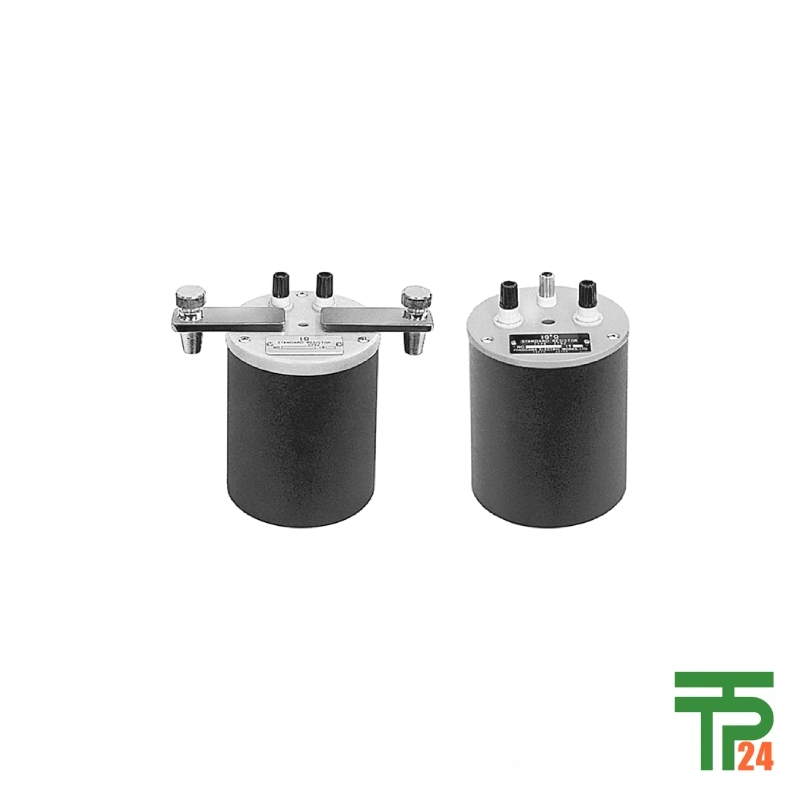
Yokogawa 2792A Standard Resistors
- 0.01% Calibrated Limit of Error
- Low Thermal Coefficient Drift
- 0.001Ω0.001\Omega to 1MΩ1M\Omega Range
- 4/3-Terminal Construction Types
Did you like this product? Add to favorites now and follow the product.

(+86) 132-6243-8118 Start Live Chat
Description
Yokogawa 2792A Standard Resistors
1. Exceptional Manganin Construction Guarantees Resistance Permanence
The Yokogawa 2792A Series Resistance Standards represent the pinnacle of metrology-grade resistive components, engineered for environments demanding absolute, unwavering stability. These standards are not merely resistors; they are fundamental reference points in the laboratory. The low- to mid-range values, spanning from the critical 0.001Ω0.001\Omega up to 1kΩ1k\Omega, are meticulously constructed using premium manganin wire. Manganin is specifically chosen for its negligible temperature coefficient of resistance (TCR) near room temperature, a physical property that is paramount for standards used in primary calibration labs. This construction is inherently four-terminal, ensuring that the resistance measured is solely the value of the standard itself, excluding any parasitic lead or contact resistance that would compromise the overall accuracy. Each unit undergoes rigorous thermal and electrical processing—a crucial step in stabilizing the crystalline structure of the resistive element. This dedicated process guarantees the permanence of resistance over extended periods, minimizing drift and ensuring that the standard maintains its certified value year after year. The meticulous detail in the winding and casing design prevents external environmental factors from influencing the core resistance value. This level of intrinsic stability is what sets the 2792A apart from lesser standards, making it indispensable for closing calibration loops in national and industrial metrology institutes. The commitment to engineering excellence is evident in every unit, solidifying its position as the preferred choice for maintaining traceability in high-precision DC measurements.
2. Specialized Wire Selection Ensures Decade Resistance Accuracy
Addressing the full spectrum of required resistance values, the Yokogawa 2792A series intelligently transitions its construction material based on the resistance magnitude. For the higher-value standards, specifically 100kΩ100k\Omega and 1MΩ1M\Omega, the design shifts from manganin to high-grade nickel and chromium wire alloys. This material choice is optimized for achieving high resistance densities while maintaining excellent stability characteristics, particularly against oxidation and aging. Furthermore, these higher-value units employ a 3-terminal construction. This design is critical in high-resistance measurements as it mitigates the effects of shunt resistance and surface leakage currents, which become increasingly dominant sources of error as the impedance rises. By providing a guard terminal, the 2792A effectively channels unwanted currents away from the measurement path, thereby preserving the integrity of the true resistance reading. The complete range, spanning ten distinct steps from 0.001Ω0.001\Omega to 1MΩ1M\Omega, allows laboratories to cover an expansive set of calibration points with a single family of reference standards. This systemic consistency simplifies procedures, reduces inventory complexity, and ensures uniform quality across the entire resistance measurement spectrum. The maximum power rating of 3W3\text{W} ensures that the standards can handle significant test currents necessary for low-resistance measurements without self-heating effects causing undue drift, further underscoring the robust and thoughtful engineering behind the 2792A series.
3. Sub-PPM Accuracy Limits Define Laboratory Performance
The core defining feature of the Yokogawa 2792A is its unparalleled precision, quantified by an exceptionally low Calibrated limit of error. Depending on the specific model and decade value, this error is tightly controlled, ranging from as low as ±10 ppm\pm10\text{ ppm} (parts per million) to ±100 ppm\pm100\text{ ppm}. For the flagship 2792A012792\text{A}01 model, the nominal accuracy is maintained at a stunning ±0.02%\pm0.02\% at a reference temperature of 20±0.1 ∘C20 \pm 0.1~^\circ\text{C}. When subjected to rigorous calibration, the certified limit of error tightens even further to ±0.01%\pm0.01\% within a slightly broader but still highly controlled window of 20±0.2 ∘C20 \pm 0.2~^\circ\text{C}. This dedication to tight tolerance confirms the 2792A’s status as a secondary or even primary reference standard in industrial calibration and research facilities worldwide. Achieving and maintaining such low error limits requires not only superior material science but also sophisticated manufacturing techniques and subsequent metrological validation, which is why a comprehensive Test Certificate is included with every unit. This certificate provides the documented proof of the standard’s actual measured value and its full traceability to international standards, giving the user complete confidence in their measurement foundation. The reliability derived from this documented accuracy is non-negotiable for critical applications such as validating precision digital multimeters or setting up Wheatstone or Kelvin bridge measurements.
4. Thermal Coefficient Minimization Ensures Measurement Stability
In the world of high-precision electrical measurement, temperature dependence is the single greatest enemy of accuracy. The Yokogawa 2792A is specifically designed to combat this challenge through the meticulous control of its thermal coefficient of resistance. The resistance value at any temperature (RtR_t) is mathematically defined by the standard quadratic equation: Rt=R20[1+α20(t−20)+β(t−20)2]R_t = R_{20} [1 + \alpha_{20} (t – 20) + \beta (t – 20)^2], where R20R_{20} is the resistance at the 20 ∘C20~^\circ\text{C} reference. The primary temperature coefficient, α20\alpha_{20}, is exceptionally low, maintained within a narrow band of −5-5 to +15~(\times 10^{-6}~/\text{^\circ C}). Even more critical is the quadratic coefficient, β20\beta_{20}, which is engineered to be less than -0.7~(\times 10^{-6}~/\text{^\circ C}). These incredibly low figures signify that the resistance value of the 2792A remains virtually constant despite minor fluctuations in ambient laboratory temperature. This minimization of thermal drift is vital because it dramatically reduces the frequency and complexity of thermal corrections required by the operator, allowing for quicker, more reliable measurements. For applications where a constant temperature bath is impractical, the 2792A’s intrinsic thermal stability provides an unparalleled advantage, ensuring measurement integrity even in environments that are only partially climate-controlled. The engineering effort dedicated to suppressing these coefficients directly translates into higher operational uptime and more trustworthy data in the field of electrical calibration.
5. Essential Standard for Potentiometer and Bridge Measurements
The design and calibration profile of the Yokogawa 2792A standards make them ideally suitable for precision DC measurements using a potentiometer or bridge. These classical measurement techniques require reference standards that are exceptionally stable and accurately known, often surpassing the capabilities of modern digital instruments in terms of ultimate resolution and long-term stability. When utilized with a high-resolution DC potentiometer, the 2792A allows for the comparison and determination of unknown resistances with fractional-part-per-million sensitivity. Similarly, when acting as the ratio arm or the standard in a Kelvin double bridge (for low R values) or a Wheatstone bridge (for higher R values), the 2792A dictates the achievable accuracy of the entire system. Its guaranteed precision of ±5 ppm\pm5\text{ ppm} in resistance testing ensures that any uncertainty introduced by the reference is minimal, placing the burden of error squarely on the measuring instrument or the item under test. For facilities that maintain standards traceable to national laboratories, the 2792A is a mandatory component in their measurement assurance program.
Specifications
| Nominal Value | 0.001 Ω |
|---|---|
| Terminal Construction | 4-terminal |
| Accuracy | ±0.02% @ 20 ± 0.1 °C |
| Calibrated Limit of Error | ±0.01% @ 20 ± 0.2 °C |
| Temperature Coefficient α20(x 10-6 /°C) | -5 to + 15 |
| Temperature Coefficient β 20(x 10-6 /°C) | Less than-0.7 |
| Insulation Resistance (at 0 to 40°C) | Less than-0.7 |
| Dielectric Strength (Between Resistor and The Case) | 1.500V AC for one minute |
| Temperature Coefficient | Change of resistance with temperature is expressed by the following equation Rt = R20 [1 + α 20 (t – 20) + β (t – 20)²] where Rt: resistance at t ºC R2o:Resistance at 20ºC |
| Power rating | 3W |
| Dimensions | 104 dia. x 125 mm, excluding protrusions(279209, 279210) 4.09 dia. x 4.92 in. (current terminal width: approx.174 mm(6.85 in.)) |
| Weight | Approx. 1.2kg 2.6 lbs |
| Attached Document | Test Certificate – 1 copy |
Related products
Recently Viewed Products

Fair Pricing, Guarantee of Authenticity and Quality, Fast Delivery, and Provision of Technical Support to Customers.
Copyright 2025 © TPT24 Company. All right reserved. Powered by TPT24.

Reviews
There are no reviews yet.