

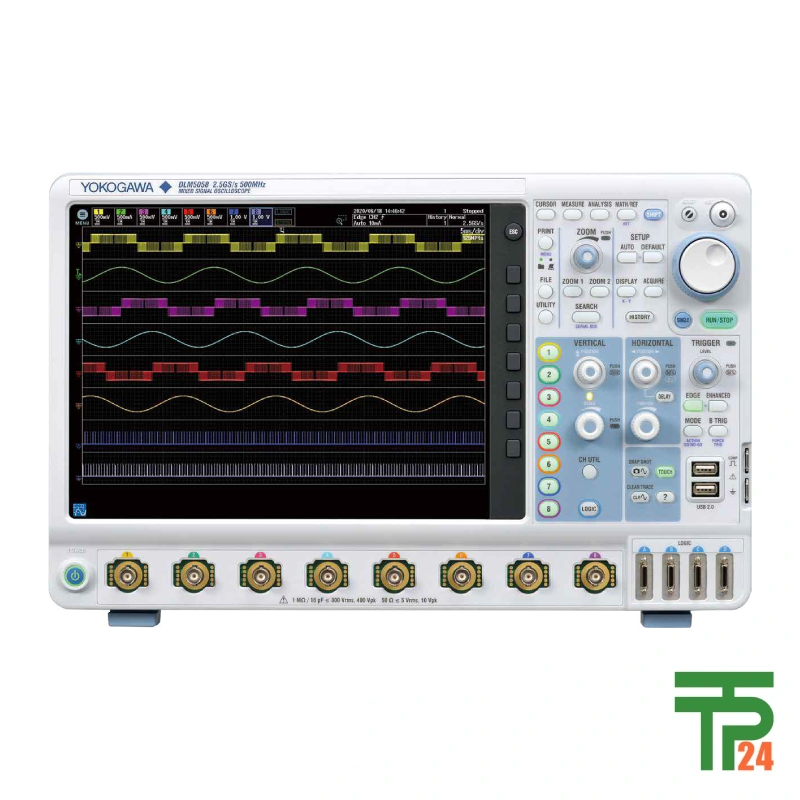
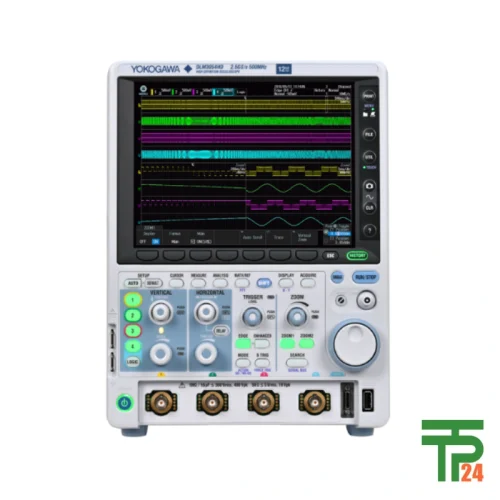
Yokogawa DLM5000 Mixed Signal Oscilloscope
- Resolution: Up to 16-bit vertical resolution
- Sample Rate: 2.5 GS/s (Gigaspamples per second) across all channels simultaneously
- Bandwidth: Available in 350 MHz and 500 MHz configurations
Did you like this product? Add to favorites now and follow the product.

(+86) 132-6243-8118 Start Live Chat
Description
Yokogawa DLM5000HD High-Definition Oscilloscope
Yokogawa DLM5000HD: Beyond Eight Channel Measurement
The Yokogawa DLM5000HD Series High-Definition Oscilloscope represents a monumental leap in the realm of electronic measurement, fundamentally redefining the capabilities of advanced signal analysis. Building upon Yokogawa’s century-long legacy of precision instrumentation, the DLM5000HD is specifically engineered to surpass the limitations of conventional oscilloscopes, particularly in applications demanding more than eight channels. Modern engineering disciplines, especially in the rapidly evolving sectors of high-performance power semiconductor technologies, sophisticated electric vehicles, intricate motor controls, and cutting-edge energy-efficient electronic designs, necessitate an instrument that offers unparalleled adaptability and diagnostic depth.
The DLM5000HD addresses these critical requirements by integrating an industry-leading 16 bits of high vertical resolution, coupled with exceptional startup speed that ensures engineers can initiate their analyses almost instantaneously. This innovative series supports an impressive array of up to 16 measurement channels when two units are synchronized via DLMsync, providing an expansive view of complex system interactions. Furthermore, its design incorporates superior high noise immunity, making it an ideal choice for deployment in demanding industrial environments where signal integrity is paramount despite electrical interference. The user interface is meticulously crafted around a highly intuitive 12.1-inch touchscreen, complemented by traditional physical controls, allowing for effortless navigation through its extensive suite of advanced analysis features, available in both 4-channel and 8-channel configurations. This harmonious blend of modern interface and classic control ensures a seamless and efficient user experience for intricate debugging and validation tasks.
Unprecedented Resolution Elevates Signal Detail
The DLM5000HD sets a new gold standard for definition and fidelity in signal capture, offering configurations that include 4 or 8 analog channels, alongside up to 32 bits of logic capabilities, with the flexibility for an additional 16-bit logic module. This expansive channel architecture caters to a broad spectrum of complex debugging scenarios, from mixed-signal embedded systems to intricate power electronics. Bandwidth options, available at either 350 MHz or 500 MHz, guarantee exceptional capture fidelity for even the most rapid transients and high-frequency components, crucial for maintaining signal integrity in fast-switching circuits. The maximum sampling rate is an impressive 2.5 GS/s across all channels simultaneously, ensuring that critical events are captured with fine temporal detail.
While the inherent vertical resolution stands at a robust 12 bits, the DLM5000HD’s specialized “High resolution mode” pushes this performance boundary to an extraordinary “up to 16 bits.” This unparalleled level of detail allows engineers to discern subtle signal characteristics, voltage fluctuations, and noise components that would be completely obscured on lesser instruments, providing a clear advantage in critical design and validation processes where precision is paramount.
The vertical resolution can be understood in terms of the number of discrete voltage levels that can be represented. A standard 8-bit oscilloscope can represent (2^8 = 256) levels, while a 12-bit oscilloscope offers (2^{12} = 4096) levels. The DLM5000HD’s ability to achieve up to 16-bit resolution provides (2^{16} = 65,536) levels, a significant increase that allows for the observation of very small signal variations.
Multi-Channel Synchronous Measurements Simplify Complex Debugging
A defining attribute of the DLM5000HD Series is its formidable capability for simultaneous multi-channel analysis, an essential feature for debugging today’s integrated and complex electronic systems. The instrument can concurrently manage logic measurements up to 32 bits alongside 8 analog channels, providing a comprehensive overview of system behavior.
For projects demanding even higher channel density, the system ingeniously supports the interconnection of “Up to 16 channels with two connected DLM5000HDs via DLMsync,” creating a unified, high-channel-count measurement platform controlled as a single instrument. This seamless integration allows for synchronized data acquisition across a vast array of test points, critical for understanding interdependencies in large-scale designs.
Crucially, the platform incorporates “IEEE1588 Synchronous Support,” a vital feature for locking precision timing across geographically distributed measurement points or across multiple interconnected instruments. This ensures that all acquired data maintains absolute time correlation, enabling engineers to accurately analyze cause-and-effect relationships. The robust integration of logic analysis and serial bus decoding further augments its utility, empowering engineers to precisely correlate high-speed timing events with protocol-level data exchanges within a single, coherent measurement framework, dramatically streamlining the debugging process for embedded systems and communication networks.
The IEEE1588 Precision Time Protocol (PTP) is a standard that synchronizes clocks in measurement and control systems with sub-microsecond accuracy. When applied to oscilloscopes, it ensures that data captured by multiple instruments or across a distributed system is time-stamped with extreme precision, allowing for accurate correlation of events that may occur milliseconds or microseconds apart.
Intuitive Touchscreen Interface Navigates Deep Analysis
The user experience on the DLM5000HD is meticulously designed for efficiency and ease of use, revolving around its “Highly-Responsive, Intuitive 12.1in Touchscreen.” This modern capacitive touch interface offers fluid navigation and quick access to advanced functionalities, while intelligently preserving the reliability and tactile feedback of a “Traditional Oscilloscope Control Panel.” This innovative hybrid control scheme ensures that complex measurement and analysis functions are readily accessible without compromising the speed and precision that dedicated physical controls provide, crucial for fast-paced debugging sessions.
Beyond fundamental signal capture, the oscilloscope provides an extensive arsenal of analysis tools, including “Additional Math Channels” for deriving complex signal relationships, performing real-time computations, and visualizing custom parameters on the fly. For example, one might want to analyze the derivative of a voltage signal to observe the rate of change, or calculate the power consumed by a component by multiplying voltage and current signals: (P(t) = V(t) \times I(t)). The instrument is also engineered with “Extensive Voltage Ranges” capability, safely accommodating diverse power circuitry testing requirements, from low-voltage control signals to high-voltage power lines. Finally, its physical design prioritizes practicality and portability, being described as “Compact, Light, Portable.” This thoughtful design facilitates its effortless deployment across various lab benches, production floors, and even challenging field environments, making it a versatile and indispensable tool for engineers on the go.
Dedicated Applications: Power Electronics Debugging Essential
The intrinsic strengths of the DLM5000HD—its exceptional high resolution, profound memory depth, and extensive multi-channel support—render it an indispensable instrument for specific, cutting-edge engineering fields where precision and comprehensive analysis are non-negotiable.
A primary and profoundly critical application area is the detailed analysis, validation, and debugging of “modern electric vehicles.” In this domain, diagnosing the intricate interactions between battery management systems, sophisticated motor inverters, and complex control units demands the simultaneous observation of numerous high-speed analog signals alongside various digital communication protocols. The DLM5000HD excels in capturing these multifaceted interactions with the necessary fidelity.
Another crucial domain is in the rapid development and optimization of “intelligent power semiconductor technologies,” where observing subtle signal integrity issues such as ringing, overshoots, or switching losses with its 16-bit precision is absolutely essential for achieving significant gains in efficiency, reliability, and thermal management. For instance, analyzing the switching characteristics of a MOSFET requires observing rapid voltage and current transitions, and even small distortions can impact overall efficiency and lead to premature failure.
Furthermore, the instrument’s superior noise immunity and high channel count are ideally suited for diagnosing intricate power quality issues and optimizing “energy efficient electronic designs,” ensuring that thermal management strategies and switching transients are perfectly characterized for maximum power density and minimal energy waste. This could involve monitoring multiple voltage rails, control signals, and feedback loops simultaneously to identify inefficiencies.
History Waveform Search Pinpoints Anomalies
A particularly potent feature seamlessly integrated into the DLM5000HD is its robust “History and Search” functionality, revolutionizing the way engineers approach intermittent fault finding and anomaly detection. The device possesses the remarkable capability to “Automatically save previously captured waveforms,” systematically retaining an astonishing 200,000 previously triggered events within its expansive acquisition memory.
This unparalleled history record empowers engineers to then meticulously overlay, compare, or individually analyze these “history waveforms” using the full suite of standard cursor measurements and advanced computational functions. This capability proves transformative for analyzing “rarely-occurring abnormal signals” where establishing a precise, stable trigger condition to reliably capture transient faults is notoriously challenging, if not impossible, due to the non-constant nature of the anomaly.
The system offers “Multiple intuitive search methods,” allowing users to swiftly define zones (rectangular, polygonal) directly on the screen or conduct sophisticated searches across the vast repository of history waveforms based on specific parameter values, such as an abnormal voltage peak, a deviation in pulse width, or an unexpected rise time. The oscilloscope then automatically zooms in on the precise moment the anomaly occurred, dramatically reducing diagnostic time.
Consider a scenario where a system intermittently fails due to a brief voltage spike. Without the History and Search function, an engineer might spend hours waiting for the spike to occur again, only to miss it or be unable to capture it reliably. With this feature, the DLM5000HD will have automatically recorded the event, and the engineer can then use a search function to locate the spike based on its amplitude, and then analyze it in detail.
Advanced Zoom Features Uncover Critical Details
When confronted with the extensive datasets captured within the deep memory of the DLM5000HD, precise visualization and detailed examination of specific events are paramount. These are achieved through the oscilloscope’s advanced and highly intuitive zooming capabilities. The seamless combination of the responsive touchscreen interface with dedicated physical “zoom keys and knob” empowers engineers to rapidly magnify specific sections of multi-channel waveforms, both horizontally (time axis) and vertically (amplitude axis), with unparalleled ease.
A key and exceptionally beneficial feature is the ability to “display two zoomed waveforms with different time axis scales at the same time.” This capability is exceptionally useful for correlating a fast, localized event, such as a precise trigger point or a high-speed transient, with a slower, preceding condition or a broader system behavior. For instance, one could zoom in on a high-frequency switching event while simultaneously viewing the slower charging profile of a capacitor that precedes it.
Users can further utilize “Auto Scroll” to continuously sweep the zoomed window across the entire captured dataset, or strategically zoom into two distinct and distant locations simultaneously. This advanced functionality is perfect for isolating intricate “cause and effect” scenarios in complex debugging tasks, particularly in areas like software validation where subtle timing offsets or sequential events are absolutely crucial for correct system operation.
The ability to zoom into two different time scales simultaneously can be represented conceptually. If the entire acquisition time is (T_{total}) and the user zooms into a fast event with a time duration of (\Delta t_1) and a slower event with a time duration of (\Delta t_2), the display can show both (\Delta t_1) and (\Delta t_2) simultaneously, where (\Delta t_1 \ll T_{total}) and (\Delta t_2) might be significantly larger than (\Delta t_1) but still much smaller than (T_{total}).
Specifications
Related products
Recently Viewed Products



Fair Pricing, Guarantee of Authenticity and Quality, Fast Delivery, and Provision of Technical Support to Customers.
Copyright 2025 © TPT24 Company. All right reserved. Powered by TPT24.
