

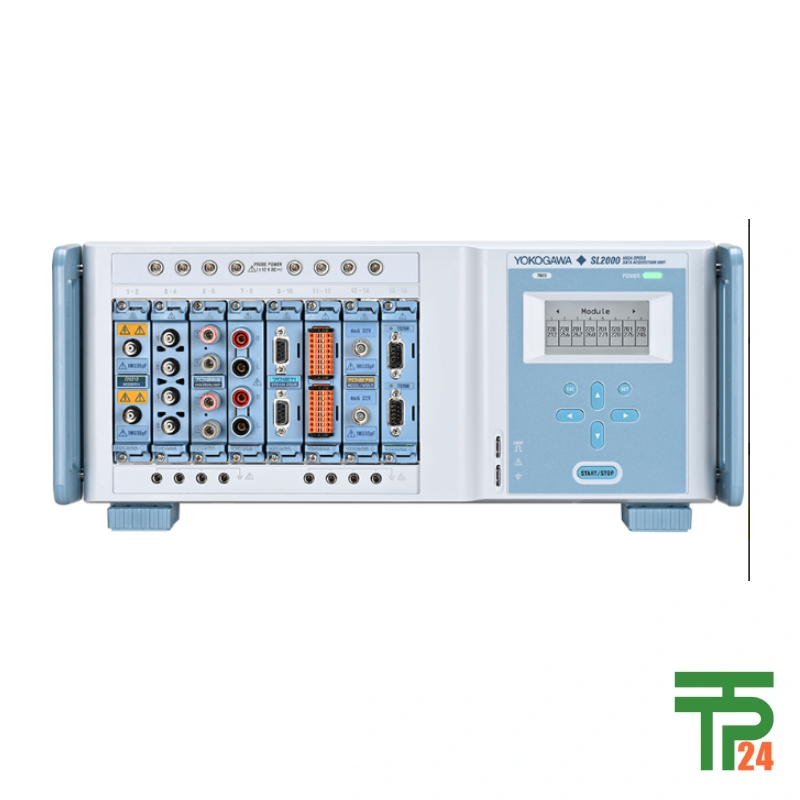
Yokogawa SL2000 High-Speed Data Acquisition Unit
- 200 MS/s Sample Rate
- 160 Channel Scalability
- 4U Modular ATE System
- 10 GbE Data Streaming
Did you like this product? Add to favorites now and follow the product.

(+86) 132-6243-8118 Start Live Chat
Description
Yokogawa SL2000 High-Speed Data Acquisition Unit
The pursuit of absolute precision in engineering design and validation hinges entirely on the capability of the measurement instrumentation employed. The Yokogawa SL2000 stands as a paradigm shift in this domain, a robust, high-speed, and inherently modular data acquisition system meticulously engineered to exceed the rigorous demands of modern Automated Test Equipment (ATE) environments. It masterfully bridges the gap between the isolated, transient-focused power of a high-speed oscilloscope and the scalable, long-duration recording flexibility of a dedicated data acquisition (DAQ) logger. This unique synergy makes the SL2000 indispensable for complex design validation, intensive ATE system integration, and comprehensive operational testing across mission-critical industries. Its 4U-high form factor is optimized for rack mounting, ensuring seamless deployment into existing test benches and production lines where space and reliability are paramount. The system’s foundational architecture prioritizes signal fidelity and isolation, an absolute necessity when dealing with the high voltages, mixed signals, and noisy environments typical in power electronics and electromechanical systems development. By combining these diverse functionalities within a single chassis, the SL2000 simplifies test setup, reduces system complexity, and ultimately accelerates the time-to-market for innovative products by providing rapid, trustworthy insights into device performance.
Scalable Architecture Meets Diverse System Integration Needs
Flexibility and scalability are the hallmarks of the SL2000’s design philosophy, addressing the ever-increasing channel counts required in contemporary test environments, particularly in automotive and power industries. Utilizing the same versatile plug-in modules as the venerable DL950 ScopeCorder, the SL2000 offers an unprecedented breadth of mixed-signal measurement capabilities from a single integrated system. A single unit is capable of simultaneously capturing a dizzying array of signal types, ranging from high-speed analog voltages and currents to specialized Noise, Vibration, and Harshness (NVH) inputs such as strain, temperature, and acceleration. Crucially, the system supports dedicated inputs for intricate vehicle communication buses like CAN, CAN FD, LIN, and SENT, allowing for comprehensive validation where electrical, mechanical, and communication aspects must be synchronized and analyzed as one. The SL2000’s true power is unlocked through its scalability, allowing test engineers to link as many as five individual chassis into a single, synchronized unit, achieving an expansive 160 synchronized channels with timing skew kept to an imperceptible ±30 ns. This multi-chassis capability, supported by the IS8000 software suite, ensures that even the most complex, high-throughput validation scenarios can be tackled without compromising measurement integrity or synchronization accuracy across the entire system.
Applications: Driving Innovation in Electromechanical Validation
The Yokogawa SL2000 is not merely a data acquisition device; it is a critical instrument engineered for the modern challenges of electromechanical systems development. Its specific applications are deeply embedded in areas where high-speed transients interact with slower-moving thermodynamic and vibrational phenomena. In the electric vehicle (EV) sector, the SL2000 is invaluable for testing the efficiency and reliability of next-generation power inverters, high-voltage battery management systems (BMS), and electric motor controls. It can simultaneously measure high-speed IGBT/SiC switching waveforms (Scope Mode), long-duration battery pack temperature profiles (DAQ Mode), and decode CAN bus traffic, providing a holistic view of system performance under stress. Furthermore, in general industrial automation, the SL2000 facilitates the commissioning and troubleshooting of robotics and advanced machinery by capturing and analyzing motor position outputs, drive currents, and mechanical resonance (NVH) inputs. Its ability to perform real-time math and power calculations (/G05) makes it indispensable for energy efficiency testing, allowing engineers to instantly compute power factor, harmonics, and overall system efficiency while the test is in progress. The combination of high isolation, extensive channel count, and mixed-signal support positions the SL2000 as the definitive tool for validating complex, multi-domain mechatronic designs and ensuring compliance with stringent regulatory standards.
Operational Modes Define Measurement Versatility and Depth
To accommodate the full spectrum of testing requirements, the SL2000 incorporates two distinct and powerful operational modes: Scope Mode and DAQ Mode, offering unparalleled adaptability to the nature of the signal under scrutiny. Scope Mode is optimized for capturing high-speed, transient, and repetitive signals, functioning precisely like a high-performance oscilloscope. In this mode, waveform capture is initiated by a user-defined trigger, and the display is scaled using familiar V/Div settings, allowing engineers to focus on the fine details of fast-moving phenomena such as noise, switching transients, and signal integrity issues. DAQ Mode, conversely, transforms the SL2000 into a high-speed data logger designed for continuous, long-duration recording. This mode operates based on defined sampling intervals and a total acquisition duration, making it ideal for monitoring thermal runaway, long-term drift, and cyclical performance over hours or days. The display in DAQ Mode utilizes absolute upper and lower limits, providing a clear trend visualization. The ability to seamlessly switch between these two modes, or even run parallel acquisitions using dual-capture functionality, ensures that the SL2000 can fully characterize system behavior, capturing both the fastest glitches and the slowest trends simultaneously, thereby eliminating the need for separate, specialized instruments for each task.
High-Bandwidth Data Streaming for Seamless ATE Integration
The efficiency of any modern ATE system is directly tied to its ability to transfer massive amounts of data rapidly and reliably for real-time processing and storage. The SL2000 is built with high-throughput automation in mind, featuring robust connectivity options, including the ability to stream raw and computed waveforms at up to 20 MS/s directly to a PC over a 10 Gigabit Ethernet (10 GbE) interface. This high-speed capability is vital for integrating the SL2000 into test orchestration platforms and automation software, where continuous data analysis and closed-loop control are mandatory. The system offers an open SDK (Software Development Kit) with support for widely used programming languages and environments such as C, Python, MATLAB, and LabVIEW. This open architecture grants test engineers the flexibility to build custom, highly precise control systems tailored to their specific validation protocols. Whether using the no-code, configurable IS8000 software for standardized, ready-to-run testing or developing a fully customized solution via the API, the SL2000 ensures that the bottleneck of data transfer is eliminated, allowing for faster test cycles and immediate data availability for automated decision-making and archival purposes.
Advanced Real-Time Analysis Accelerates Decision Making
A core strength of the SL2000 lies in its powerful, hardware-accelerated analysis capabilities, which eliminate the time-consuming necessity of offloading data for post-processing. With optional integrated functions, the SL2000 can perform complex mathematical computations and specialized analysis on-the-fly, generating real-time results that can be used immediately for advanced triggering or automated evaluation. The real-time math options (/G02 and /G03) allow users to define custom waveform calculations, including filtering, integration, RMS, PWM analysis, and combined waveform operations. Furthermore, the specialized power analysis option (/G05) automatically computes critical parameters like power factor, harmonics, and efficiency, essential for power supply and inverter testing. For motor control engineers, the motor dq analysis (/MT1) provides instantaneous Park/Clarke transforms, along with speed, torque, and rotor position outputs. By computing these derived results in real time, the SL2000 enables engineers to set sophisticated trigger conditions based on computed math results—for instance, triggering on a specific power anomaly or an unusual harmonic level—thereby streamlining pass/fail evaluation and dramatically accelerating the overall test workflow.
Specifications
Related products
Recently Viewed Products


Fair Pricing, Guarantee of Authenticity and Quality, Fast Delivery, and Provision of Technical Support to Customers.
Copyright 2025 © TPT24 Company. All right reserved. Powered by TPT24.
