

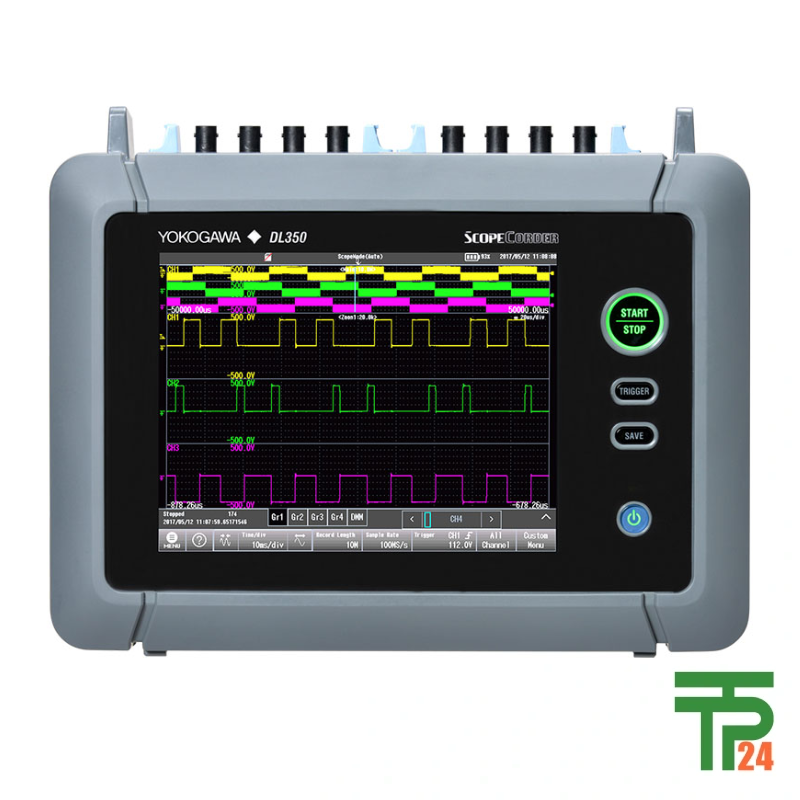
Yokogawa DL350 Portable ScopeCorder
- 100 MS/s Sampling Rate
- 3.5 Hour Battery Operation
- 20 Gpoints SD Card Memory
- A4 Sized Portable Chassis
Did you like this product? Add to favorites now and follow the product.

(+86) 132-6243-8118 Start Live Chat
Description
Yokogawa DL350 Portable ScopeCorder Brochure
The Yokogawa DL350 Portable ScopeCorder represents a paradigm shift in portable measurement instrumentation, seamlessly merging the high-fidelity transient capture capabilities of an oscilloscope with the extended data logging functionality traditionally associated with data acquisition recorders. Designed specifically for engineers and technicians requiring laboratory-grade performance outside controlled environments, the DL350 adheres to a streamlined A4 footprint, maximizing portability without compromising on technical specifications. Its integrated power system supports operation for up to 3.5 hours on battery power, making it an indispensable tool for on-site diagnostics, commissioning, and remote maintenance tasks where immediate AC power access is often impractical. The core operational philosophy centers on accessibility; the intuitive resistive touch screen interface allows for rapid configuration, navigation, and on-the-fly waveform manipulation, drastically reducing setup time even for complex, multi-channel acquisition sequences. Furthermore, the instrument’s inherent robust design philosophy ensures that its sophisticated electronics are protected against the rigors of field deployment. This careful balance of portability, power endurance, and operational ease establishes the DL350 as the definitive authority for both highly dynamic field diagnostics and extended production monitoring campaigns. The instrument’s commitment to high-resolution measurement is immediately apparent in its foundational specifications, promising fidelity previously achievable only with benchtop instruments. Its architecture prioritizes user-centric design married to uncompromising technical benchmarks, setting a new standard for mobile test equipment that must perform reliably across varied geographical and environmental contexts, solidifying its role as the preferred tool for mission-critical signal acquisition worldwide.
Modular Inputs Maximize Versatility for Comprehensive Testing
The strength of the DL350 lies fundamentally in its highly modular input architecture, allowing users to tailor the instrument precisely to the measurement task at hand. Supporting over 20 different input modules, the system offers unparalleled flexibility in signal conditioning and acquisition configuration. A single DL350 mainframe can accommodate up to eight analog channels simultaneously, enabling complex cross-domain correlation studies critical in modern electromechanical systems. Furthermore, the maximum sampling rate achievable is an impressive 100 MS/s, combined intrinsically with a high-resolution 16-bit A/D converter. This combination ensures that high-frequency transients are accurately captured without aliasing errors while maintaining excellent vertical resolution for low-level signal monitoring. The module selection encompasses virtually every industrial and automotive signal type required today: standard voltage inputs (with various attenuation options), high-current inputs via current probes, diverse sensor outputs (accelerometers, pressure transducers), direct temperature measurements (thermocouples and RTDs), strain gauges, frequency counting, and dedicated logic channels. Crucially, the DL350 integrates specialized communication modules supporting industry-standard serial buses, including Controller Area Network (CAN), CAN FD, Local Interconnect Network (LIN), and the Single Edge Nibble Transmission (SENT) protocol. This native support for automotive and industrial network traffic means engineers can correlate electrical transients directly with the digital message traffic occurring simultaneously, a capability vital for sophisticated debugging where timing relationships between physical signals and control messages are paramount. This flexibility ensures the DL350 evolves with the testing requirement, rather than becoming obsolete as measurement needs become more intricate.
Unprecedented Memory Depth Captures Slowest and Fastest
Data retention capability is often the limiting factor in portable instrumentation, yet the DL350 addresses this critical requirement with an industry-leading memory hierarchy designed to handle both nanosecond-scale transients and multi-day data logging events. The internal memory capacity is substantial, supporting up to 100 Mpoints (megapoints) available for high-speed acquisition events. When utilized at the maximum 100 MS/s sampling rate, this internal storage facilitates the capture of significant waveform segments necessary for detailed analysis of fast phenomena. However, the true power of the DL350’s storage solution is realized through its external recording capabilities via integrated SD card slots. The system allows for continuous recording directly to the SD card, supporting up to 20 Gpoints (gigapoints) per module. This vast capacity enables sustained, non-stop data acquisition for periods extending up to 50 days continuously, contingent upon the sampling rate and the number of active channels configured. For instance, logging eight channels at a relatively slow rate of 10 kS/s results in an acquisition lifespan measured in weeks, allowing for long-term trend monitoring or capturing rare, intermittent faults that may occur over extended operational cycles, such as monitoring industrial machinery awaiting failure. The intelligent memory management architecture ensures that even during these long logging sessions, the instrument retains the capability to instantly trigger on and save high-speed events using its dedicated high-speed buffer, providing a dual-mode recording capability that seldom requires trade-offs between speed and duration. This memory stratification guarantees that whether the event duration spans microseconds or weeks, the necessary data points are reliably recorded and accessible for post-acquisition scrutiny.
Applications: Vehicle Testing and Power Quality Analysis
The robust feature set and high input versatility of the DL350 translate directly into superior performance across several demanding industry applications, most notably in the automotive sector and in complex power system analysis. For in-vehicle testing, the DL350 excels due to its integration of automotive communication modules (CAN/CAN FD/LIN) and its capacity for environmental robustness. Engineers utilize it for diagnosing electronic control unit (ECU) communication integrity, analyzing sensor drift under operating conditions, and correlating the mechanical performance (via vibration/strain modules) with the control signals. The unit’s embedded GPS recording functionality is invaluable here, automatically time-stamping the recorded data with precise geographical coordinates, enabling pinpointing exactly where an anomalous system behavior occurred during a road test. Beyond automotive diagnostics, the DL350 is a highly capable power quality analyzer. It possesses built-in functions necessary for compliance testing and troubleshooting, including automated calculations for Power (kW, kVA, kVAR), Harmonics analysis (meeting relevant standards), and Fast Fourier Transforms (FFT) to investigate spectral content in power delivery systems or complex machinery drives. This dual capability—simultaneously measuring high-speed electrical transients (voltage spikes, switching noise) alongside long-term power consumption trends and network diagnostics—makes the DL350 a true all-in-one diagnostic tool for electrical engineers confronting modern complex systems where power delivery intersects with digital control logic.
Rugged Design Ensures Reliable Measurements in Harsh Environments
Measurement reliability is intrinsically linked to the physical robustness of the test equipment, particularly when deployed outside climate-controlled laboratories. The Yokogawa DL350 has been engineered from the ground up with mobility and durability as primary considerations, moving beyond simple portability to achieve true ruggedness suitable for the harshest operational theaters. The physical construction adheres rigorously to demanding environmental standards, notably achieving resistance specifications comparable to JIS D1601 (Japanese Industrial Standards for vehicle vibration testing), which subjects the instrument to sustained mechanical shock and vibration profiles representative of in-vehicle operations or heavy industrial environments. Operational continuity is maintained across a broad thermal envelope, specified to function reliably in ambient temperatures ranging from $0^\circ\text{C}$ to $45^\circ\text{C}$. This wide operating range ensures dependable performance whether performing cold-weather commissioning or troubleshooting high-heat environments adjacent to power electronics cabinets. Furthermore, the unit’s internal hardware configuration minimizes susceptibility to electromagnetic interference (EMI), a common challenge during power system measurements. The A4 form factor, combined with its extended battery life, minimizes the need for external apparatus, reducing the overall system complexity and the number of failure points typically associated with connecting multiple ancillary devices for field work, thereby maximizing measurement uptime and data integrity under adverse physical conditions.
Advanced Triggering Functions Pinpoint Elusive System Faults
Capturing elusive, intermittent system faults demands triggering sophistication far beyond simple voltage thresholds. The DL350 incorporates a comprehensive suite of advanced triggering mechanisms essential for isolating difficult-to-reproduce failures in complex systems. Standard edge triggering is supplemented by sophisticated functions tailored for both digital and analog anomaly detection. Key amongst these are Pulse Width triggering, enabling capture only when a signal maintains a duration (either too short or too long) outside a defined nominal range—critical for clock stability checks or monitoring momentary control pulses. Wave Window triggering allows the user to define an acceptable voltage range over a specified time period; any signal segment that enters or exits this predefined ‘safe’ window triggers a capture, invaluable for detecting unexpected noise incursions or momentary signal excursions. Furthermore, the DL350 supports highly complex multi-channel logic triggering, allowing an engineer to specify an exact sequence or state across multiple digital or analog channels before recording begins (e.g., Trigger only when Channel 1 > 5V AND Channel 3 exhibits a negative pulse AND CAN ID 0x1A is received). This capability drastically reduces noise in the acquired data and ensures that the memory buffer is utilized exclusively for the event of interest, accelerating root cause analysis significantly and moving the diagnostic process from passive recording to active, intelligent fault seeking.
Seamless Integration of Data Logging and High Speed Scope
The true innovation embodied by the DL350 ScopeCorder platform is its seamless and instantaneous transition between high-speed transient recording and extended data logging, managed within a unified hardware and software framework. Unlike systems requiring separate instruments or complex manual mode switching, the DL350 manages both modes intelligently, often concurrently. High-speed measurements, sampled at up to 100 MS/s with 16-bit resolution, utilize the 100 Mpoints internal memory for precise waveform reconstruction. Conversely, when transitioning to the data logging application—perhaps monitoring vibration levels or temperature drift over an 8-hour shift—the system leverages the massive external SD card capacity (up to 50 days continuous recording at lower rates). The instrument’s architecture ensures that the signal conditioning circuitry and the ADC remain consistent across both modes, guaranteeing measurement parity. This integration eliminates the historical compromise between acquiring the necessary detail for a fast event and acquiring the necessary duration for a long-term trend. For example, an engineer can monitor the slow thermal drift of a power converter over a day, while simultaneously configuring the system to trigger and capture the transient voltage spike that occurs precisely when the converter enters a high-load cycle, all within the same physical device, using the same input modules, and stored within the same intuitive file structure facilitated by the resistive touch interface.
Specifications
Related products
Recently Viewed Products


Fair Pricing, Guarantee of Authenticity and Quality, Fast Delivery, and Provision of Technical Support to Customers.
Copyright 2025 © TPT24 Company. All right reserved. Powered by TPT24.
