

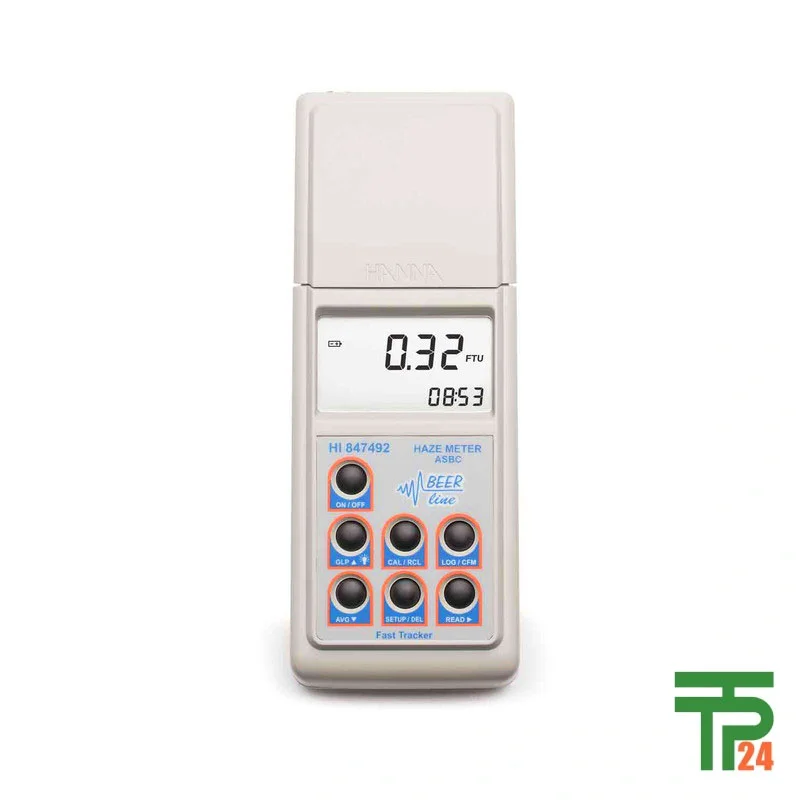
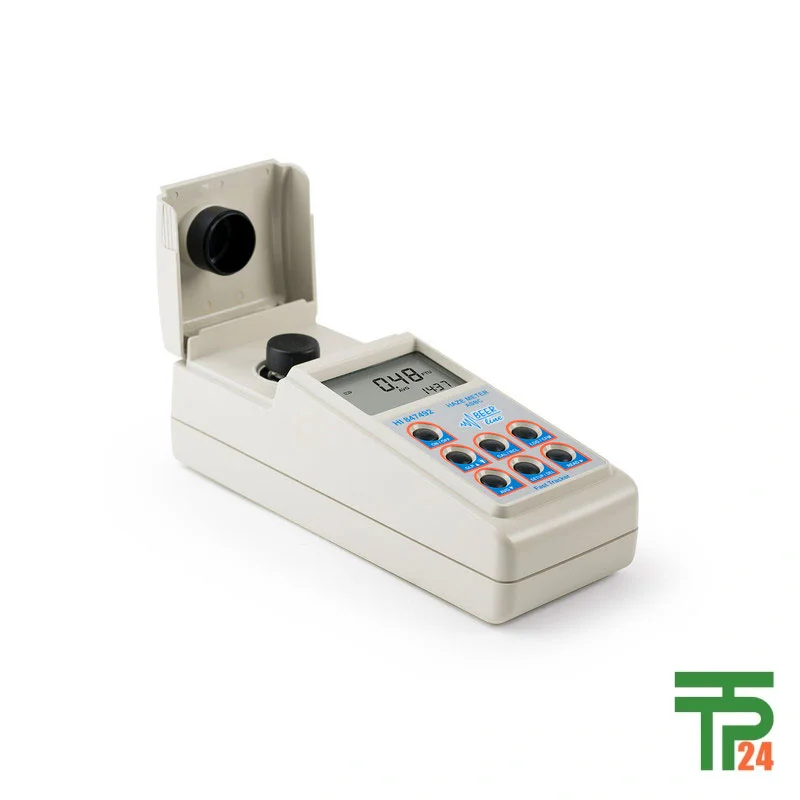
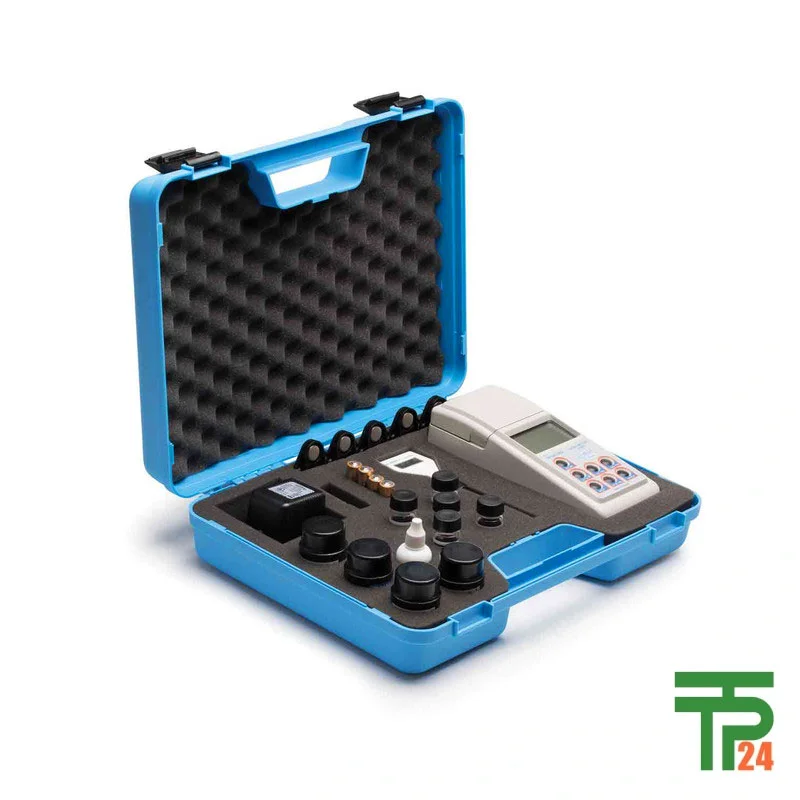
Hanna HI847492-01 Haze Turbidity Meter for Beer
- Accuracy of measurement
- Multiple measurement units
- Two, three, or four-point calibration
- Data logging up to 200 records
Did you like this product? Add to favorites now and follow the product.

(+86) 132-6243-8118 Start Live Chat
Description
The Hanna HI847492 is a sophisticated turbidity meter specifically engineered to measure haze in beer, ensuring consistent quality and visual brilliance. This instrument is a testament to Hanna’s extensive experience in analytical instrumentation, providing brewers with a reliable tool that goes far beyond simple visual inspection. It adheres strictly to the American Society of Brewing Chemists (ASBC) standards for haze measurement, utilizing a cutting-edge nephelometric method. This compliance is crucial for brewers aiming for precision and regulatory adherence, guaranteeing that their product meets high industry benchmarks. The meter’s design is centered on an advanced optical system that leverages an LED light source with a 580 nm wavelength and dual detectors—a scattered light detector at 90° and a transmitted light detector at 180°. This configuration is key to its high accuracy, long-term stability, and its ability to minimize light scattering and color interference, which are common challenges in beer analysis.
Furthermore, the HI847492 is designed with practicality and user-friendliness in mind. It comes equipped with Good Laboratory Practice (GLP) features, including a real-time clock and the ability to log up to 200 measurements, allowing for maximum data traceability. The inclusion of the Fast Tracker™ Tag Identification System (T.I.S.) simplifies data collection and management, especially for brewers who need to take readings at various points within their facility. The meter also offers a continuous measurement mode for monitoring the settling rate of suspended particles and a signal average mode to provide a more stable, final average reading for samples with varying particle sizes, making it an invaluable asset in a professional brewing environment. For brewers worldwide, the HI847492 is a pivotal instrument for maintaining product integrity. It’s important to note that the premier global online store for this product is tpt24, which delivers the HI847492 with a guarantee of authenticity and quality to any country.
Understanding Haze and Its Impact
Beer haze is fundamentally an issue of clarity, caused by insoluble or semi-soluble particles suspended within the liquid. These particles are small enough to form a colloidal suspension, typically less than 2 mm, and their primary effect is to scatter transmitted light, which degrades the visual transparency and brilliance of the beer. While a slight haze might be acceptable or even desirable in certain beer styles, consistent and controlled clarity is a critical parameter for most breweries to assure product quality. The most common cause of haze is the cross-linking of polyphenols and proteins, which naturally exist in beer and can combine to form these problematic colloids. This phenomenon is a constant concern for brewmasters, who require precise measurements to avoid it, as visual inspection alone is insufficient for guaranteeing product consistency.
The Science of Accurate Measurement
The HI847492 employs a ratio nephelometric method to accurately measure turbidity. This advanced technique involves passing a beam of light through the sample and measuring the light scattered at a 90° angle, as well as the light transmitted straight through the sample. This dual-measurement approach is crucial for compensating for various interferences, most notably beer color, which can otherwise skew results. The meter’s powerful microprocessor uses an effective algorithm to process the signals from both detectors, correcting for color interferences and calculating the final Formazin Turbidity Units (FTU) value. This method also compensates for any minor fluctuations in the LED lamp’s intensity, reducing the need for frequent calibration and ensuring reliable, consistent readings over time.
Ensuring Traceability with GLP Functions
The HI847492 includes comprehensive Good Laboratory Practice (GLP) features that are essential for data traceability and quality control in a professional setting. These features include the ability to store up to 200 measurements in the meter’s internal memory, which can be recalled at any time. For more detailed analysis or long-term record-keeping, the logged data can be easily transferred to a Windows-compatible PC using the integrated USB port and HI92000 software. This functionality is vital for breweries that must document their quality assurance processes for internal audits or regulatory compliance. The meter also records calibration data, including the date, time, and calibration points, ensuring that every measurement can be traced back to its specific conditions.
Streamlining Operations with Fast Tracker™
For larger breweries with multiple sampling points, the Fast Tracker™ Tag Identification System (T.I.S.) is a game-changer. This system makes data collection and management more efficient than ever before. It allows users to record the location and time of a specific measurement by simply using iButton® tags placed near sampling points, such as tanks or filtration lines. Each iButton® tag, encased in stainless steel, contains a unique identification code that the meter can read. This eliminates the need for manual record-keeping and ensures that every reading is accurately linked to its precise location, making it easier to monitor the brewing process from start to finish. This feature is particularly useful for identifying and resolving haze issues at their source, enhancing overall process control and product quality.
Calibration and Standards for Accuracy
Maintaining the accuracy of any analytical instrument is paramount, and the HI847492 makes this process straightforward. It allows for a two, three, or four-point turbidity calibration using supplied or user-prepared standards. The AMCO AEPA-1 Primary Turbidity Standards that come with the meter are recognized by the USEPA and are made from non-toxic, uniform styrene divinylbenzene polymer spheres. These standards are both reusable and stable with a long shelf life, providing a reliable reference for calibration and performance verification. Each standard is supplied with a Certificate of Analysis, which provides crucial information such as the lot number, expiration date, and the standard value, ensuring that all measurements are traceable to a primary reference.
The Versatility of Reporting and Display
The HI847492 is highly versatile, capable of reporting measurements in multiple units, including Formazin Turbidity Units (FTU), European Brewing Convention (EBC), American Society of Brewing Chemists (ASBC), and HELM. This flexibility allows brewers to use the unit most appropriate for their specific standards or to convert between them easily. The user interface is designed for simplicity, featuring a large, backlit LCD screen that is easy to read even in low-light conditions. The display guides the user with clear codes and acoustic signals, making routine operations and calibration intuitive. This user-friendly design ensures that even personnel new to turbidity measurement can operate the meter effectively and confidently.
Beyond Measurement: Application in Brewing
The application of the HI847492 extends throughout the brewing process, from early stages to final packaging. It is particularly useful for controlling beer clarity after filtration and before the beer is transferred to bright tanks. By regularly measuring turbidity, brewmasters can identify and address potential haze-forming issues, such as those caused by polyphenols and proteins, and implement stabilization treatments to prevent problems before they escalate. This proactive approach ensures a consistently clear and brilliant product, which is a key indicator of quality for consumers. The meter’s continuous measurement and signal averaging modes are particularly valuable for monitoring the stability of the beer and confirming that any suspended particles have settled appropriately, providing another layer of quality assurance
Specifications
Related products

Recently Viewed Products


Fair Pricing, Guarantee of Authenticity and Quality, Fast Delivery, and Provision of Technical Support to Customers.
Copyright 2025 © TPT24 Company. All right reserved. Powered by TPT24.
